Me with my lovely wife, Kathy:

Monday, November 23, 2020

Something Best Enjoyed in Pajamas with a Snuggle on the Side

 The Christmas season will soon be upon us. Unfortunately, the Covid season still hangs on. Perhaps this little bedtime story will help soften the edges of this time that is hard for young and old.


A Lost Donkey Finds His Momma, And . . .
by, Howard Merrell


Dudley just couldn’t hee-haw any more.  For a while he was glad that Daddy Donkey wasn’t there.  Daddy Donkey always said, “If you want to amount to anything like your Grandpa Darius Donkey, you have to learn to “hee-haw” with royal authority.  The lesser beasts should hear you at least a mile away.” 

Dudley had practiced and practiced until his hee-haw shook the leaves on the bushes.  Not as good as grandpa Darius--he could make the palm trees sway-- but not bad for a little donkey. 

Earlier in the day when Dudley called out to Momma Donkey he was at his best.

Sheila Sheep looked at him and said “Baa.”

Cameron Camel slowly turned his head toward Dudley and slobbered in recognition.

Doreen Dove lighted on the bush next to him and said “Coo, coo.”

Howard Horse trotted by and whinnied in reply.

Even Baxter Buzzard swooped down to get a closer look.

But no matter which way Dudley turned his big floppy ears he couldn’t hear a Momma “hee-haw” reply.   Momma Donkey didn’t answer.

It all started a few days earlier, a long way from here, up in Nazareth.  Joseph, Momma and Dudley’s kind owner came and put the halter and blanket on Momma and said something about a trip to Bethlehem.  Dudley had never heard of Bethlehem so he figured it must be far.  If Momma was going to Bethlehem, what would happen to him?  Momma was telling Dudley to “Just be quiet.  It will be all right.”

But before she finished Dudley let out the saddest most pitiable “Hee-haw,” you ever heard. 

Joseph looked at the little donkey and rubbed him right at the base of his ears.  Dudley loved that.

“Why little fellow, you act like you can understand what I say, but don’t worry.” 

As Joseph spoke Dudley snuggled his head in the carpenter’s course woolen robe.  Sometimes the little donkey would find an apple or some other treat, but not today.
“Don’t worry little fellow.  You can tag along.  I guess the Romans will count you, too, and probably charge me more taxes, but I won’t leave you here by yourself.”

With that, Dudley looked so relieved, that Joseph just stood there in amazement.  “Sometimes I think that donkey understands every word I say.”  Joseph spoke out loud, but to no one in particular. 

Right then, Momma gave Dudley “the look.”  You know, the look that means, “Don’t you dare” do whatever it is that you were thinking about doing right before she gave you the look.   So Dudley just munched some hay, acting like he had no idea what Joseph said.

But he did.

Joseph gathered some hay and grain into a sack, and leading Momma out, said, “Come on Little Fellow.”  Joseph didn’t know the little donkey was named Dudley.  “You just follow behind your momma.”

And Dudley did just that.

Where is this Bethlehem place, where they were going?

Why were they going there?

When would they come back?

Dudley was full of questions, but he knew they would have to wait.  Right now he just watched.  Joseph very carefully and tenderly helped his wife Mary onto Momma’s back.  Dudley had heard not only from Momma, but from listening to the people talk that Mary was going to have a baby very soon.

“I wonder why we’re going to this Bethlehem place, right now?” He wondered.  But that was just one more question that had to wait. 

Joseph, and Mary and Momma went right down the path that led to the Jordan River, far below in the East.  Dudley went from one bush, to a butterfly, to an interesting looking rock, to a flower, to another bush, to an anthill.  If he got too far from the path he would hear Momma call.  Dudley was surprised that Mary and Joseph didn’t seem to hear when Momma would call his name, but Dudley could hear just fine, and when he did, he’d say, “Ok, Momma,” and bound back toward the little travelling group.  Mary would smile a tired smile when she saw him, but she never seemed to hear.

“Hmmm?”  thought Dudley, “another question.”

That night, Joseph found a place for his little family to spend the night.  Dudley listened to Mary and Joseph talk and knew they weren’t in Bethlehem, yet.  They still had several days of walking.

After some hay and a nice roll in the dust Momma was ready for sleep, but Dudley had so many questions.

“Just one, Dudley.”

“Aw, Momma, two?”

“No, I’m tired, and we both need to sleep.  We have another long trip tomorrow.  Just one.”

“OK.  Momma.  Why do the people always act surprised when we act like we understand them?”

“Oh, I’ve been wondering when you would ask about that.  Do you see these big ears that Lord God gave us?”

Dudley nodded.

“Well these ears let us hear so much more than the people hear that when we talk we talk so quietly that they can’t hear us.”  So they don’t know we can talk, and I guess they just assume that we don’t understand either.”

“But Momma, why do you and Daddy Donkey, and Grandpa Darius always act like you don’t understand anyhow?”

“Well, young donkey, that is another question, but I’ll answer it anyhow.  We do that because it is easier.  We really know what they are saying, but we act like we don’t.”

“Is that why you gave me the look, when we were back at Joseph’s house?” 

“Now that’s three!  But, yes, that’s why I let you know you should play dumb.  The look! Indeed! You must have been talking to your Daddy again.  Now, get to sleep.”

It was dark and Dudley couldn’t see, but he knew Momma was giving him the look.  Soon he was fast asleep.

It was late in the evening when Joseph and his family arrived in Bethlehem.  The trail was full.  There were people, and horses, and camels, and more people, and Dudley knew Joseph was in a hurry.  Momma tried to hurry without jostling Mary, but even Dudley knew the time for her baby to be born must be soon.  As they were hurrying along a big group of Roman soldiers came by.  The flags floating in the breeze, the big fierce looking horses and the shiny brass armor on the men dazzled Dudley.  Dazzled him so much that he lost sight of Momma, and all the hoof beats, and soldiers talking, and merchants yelling, and camels grunting, and strange donkeys hee-hawing was so loud that Dudley couldn’t hear Momma either, and now he was lost. 

He went on in the way he thought they would have gone, but even when he did his best Grandpa Darius Hee-haw, he couldn’t hear any reply.  Soon he got even loster, and the sun was going down, and he got cold and loster.  Now, he wouldn’t have cared if Daddy Donkey teased him about his pitiful little Hee-haw, he would have loved to see somebody he knew, but no one answered, and the darker it got, the loster Dudley got, and the colder, and the sadder, and the . . .

Until he couldn’t “Hee-haw” any more.

All that came out was, “sniff – snuff.”

Poor Dudley’s head was down between his legs and his ears were dragging the ground when he smelled something.  Donkeys can smell almost as well as they can hear.

“Sniff, sniff, sniff,” went Dudley as he lifted his head into the breeze.

“I know that smell.”

“It’s fire.”

“People make fire to keep warm.”  Just thinking the word made Dudley feel better.

Dudley started walking in the direction of the smell. 

“Maybe, thought Dudley, “these are my people,” and if they are my people, Momma will be there!” 

Dudley was trotting now.  Soon he could see the glow of the fire behind some rocks.  He was running now.  He burst into the little group around the fire, but they weren’t his people and Momma wasn’t there. 

Dudley’s head hung, and his ears drooped.

“Hey, little fellow.”  Said one of the shepherds sitting around the fire.

“How’d he know to call me that?” thought Dudley.  “That’s what Joseph calls me.”

But the fire looked so warm--and could it be?  Was that man holding out an apple?--that Dudley moved closer to the fire, and took the apple from a little shepherd’s hand.

That’s when it happened!

Suddenly the sky was as bright as noonday.  All the shepherds fell on the ground like they were dead.

Dudley didn’t know what it was.  It looked like a man, but it was like it was made out of fire, only much brighter than the fire around which the shepherds had been huddling.

“Do not be afraid;” the thing in the sky said, with a voice like a people voice, but as loud as Grandpa Darius’s hee-haw.

“ for behold, I bring you good news of great joy which will be for all the people; for today in the city of David there has been born for you a Savior, who is Christ the Lord. “This will be a sign for you: you will find a baby wrapped in cloths and lying in a manger.” (Luke 2:10–12, NASB95)

Then the sky was full of these creatures of light saying with a sound that Dudley thought would split the rocks, “Glory to God in the highest, And on earth peace among men with whom He is pleased.” (Luke 2:14, NASB95)

Then they were gone.  The shepherds just stared at the black sky, dotted with stars, wondering where these marvelous creatures had gone. 

Then one of the shepherds, one with a big black beard like Joseph’s, said, “Let us go straight to Bethlehem then, and see this thing that has happened which the Lord has made known to us.”

Dudley’s little donkey brain was all in a whirl.  Didn’t those wonderful creatures in the sky say something about a baby?  Could it be Mary’s baby?  And it if it was Mary’s baby then Momma couldn’t be far off.

So when the shepherds picked up their staffs and tied their robes around their waists, Dudley followed right behind.  They “came in a hurry and found their way to Mary and Joseph, and the baby as He lay in the manger.” 

Soon the shepherds left.  They told everybody they saw about what they had seen.  Dudley’s big floppy ears could hear them talking a long time after they left.  In fact he could still faintly hear them when he drifted off to sleep snuggled close to Momma.


Friday, November 6, 2020

The Closing Of, The Slouching Toward, and The Disposal of Unsalty Salt That Led to This Mess

 One of the things, concerning American politics, that I have thankfully observed over the years is the orderly transfer of power that takes place from one election cycle to another. Unfortunately, I see evidence that this might not be the case this time around. Personally, I don't think the chances of wide-spread violence are very high. I definitely don't see a coup in the works, but I can't ignore the recent demonstrations--some of which became riots--or the fact that some businesses and offices in major US cities have proactively boarded up their places of business against the possibility that some might "take things to the street." We pridefully claim that we aren't a "banana republic," but could we just be a republic with more bananas?

During my lifetime, to one degree or another, the United States was influenced by respect for authority, fairness, and the rule of law, that found its roots in Judeo-Christian values. I'm not saying that most of my countrymen of 40, 50, or 60 years ago were Christians (or Jews). They weren't. But, my nation was still strongly influenced by values that were in many cases drawn from Scripture, or from the natural

law that is parallel with Biblical ethics. 

I came of age in the late 60s. As a boy growing up with Beaver Cleaver in the 50s I was aware of President Eisenhower. Mostly I remember that he played golf. He considered himself to a very religious man, but he was not a part of any church. I would say that most of the adults around me in my growing-up years shared that sentiment. It was my dad's view (until he turned back the Lord in a personal way, just after I started college). People had a religion and set of values that were handed to them. Most did little if anything to strengthen that package and make sure it maintained its relevance so it could be passed on to the next generation. 

Two books that helped me, later in life, to see what was going on in my youth are The Closing of the American Mind, by Allan Bloom, and Slouching Toward Gomorrah, by Robert Bork. To use a Biblical picture, our salt became saltless and it was therefore good for nothing except to be thrown out and walked on. Even later, Cornelius Plantinga's book, Not the Way it is Supposed to Be, A Breviary on Sin, helped confirm and tidy up my thinking.

So, what do we do?
  
The simple answer is--and it's not wrong just because it is simple--to do right.

      He has told you, O man, what is good; 
      and what does the LORD require of you 
                  but to do justice, and to love kindness, 
      and to walk humbly with your God? 
(Mic 6:8)

Beyond that, or perhaps I should say, "within that" let me offer a couple of thoughts:
  • Do what you can, where you can. Spend less time railing, or fretting, or rioting about what is going on Washington, or Palikir, or . . . and more time reaching out with kindness to your neighbors.
  • Don't just coast, based on the moral/ethical capital of the past. Live, work, and minister in such a way that you are adding to the supply of salty salt that will help preserve coming generations from the kind of rot we see around us today. 
  • Discipline yourself to discriminate between the person who holds the view to which you object, and the view held by that person. That person is created in God's image, one for whom Christ died, and she or he is a repository of unimaginable potential. That view you despise may be despicable. That person is redeemable.
  • Think! Don't just feel. 
  • Listen more. Talk less.
  • Don't shout (unless you are warning someone of a disaster.)
  • Seek to understand.
  • Be kind.
  • Know that God has gotten along just fine while all kinds of governments and governers functioned in this world. Our hope is in him.
Live for Jesus.

Friday, September 4, 2020

The Jerry Fallwell Jr./Liberty Mess

 To say, "I'm conflicted" about the recent news in regard to Jerry Fallwell Jr. and Liberty University is a definite understatement. I'm a graduate of Liberty Seminary. I did most of my work by driving the one-hundred miles to Lynchburg once a week. Even then--late 80s and early 90s--I had "issues" with some things the Senior Fallwell was doing. I remember a conversation I had with a classmate and Fallwell aid about Jerry Sr. taking over PTL. My friend reported that folk in the office tried to talk Jerry out if it. They were right. I attended an "I Love America" rally, and was friends with the star of the show, Robby Hiner, but I became comfortable with the position of a couple of other (former) Fallwell associates, Eddie Dobson and Cal Thomas. They state their case in a book they co-wrote, Blinded by Might. I had gotten to know Dobson, through a mutual friend. From a distance, I watched him move away from the politics-is-the-answer, position to a Gospel-centered ministry. My experience, for what it is worth, has proven Thomas and Dobson to be right. (I don't want to give the impression that Jerry Sr. and Thomas Road Baptist abandoned the Gospel. They didn't.)

Still, my experience at Liberty was a good one. Frank Schmidt, James Borland, Ron Hawkins, and Norm Giesler, are names of teachers who still stick in my mind. They were/are good guys. I never attended chapel; it was long over before a arrived for class, late in the afternoon. About my only campus experience was parking on the lot. As I recall about the only time "Jerry's" political adventures came up in class were in good-natured jokes. As a pastor well within the circle of influence of Liberty, I was glad for my over-sized neighbor (I speak of Thomas Road Baptist and Liberty, not Jerry Sr.) I saw several young people from the church I pastored go to Liberty, including my son. By and large, they had good experiences. 

My conflict is further conflicted by the fact that Jerry Jr. and I have something in common. We both lead (in his case led) Christian Universities. His, one of the largest, mine, one of the smallest in the world. Let me be clear: If half of what is reported about the current scandal is true it is far beyond excuse. I'm just saying, there is a place in my heart for those who sit in the chair.

With all that said, I'm trying to learn from what is going on at my Alma Mater.

  • God can use anybody He wants to use, but from our perspective down here, God's work ought to be done by God's people.
    Those of us who have watched Liberty since the death of Jerry Sr. have noticed a disturbing drift. Here, I'm not talking about the move back in a political direction. I'm talking about using the metric of success as the chief measurement of whether an organization is doing the right thing. Jerry Jr.'s statements about not being a pastor, given with the implication that this allows him greater ethical freedom, is a very harmful notion. If one is not prepared to lead a Christian institution in a Christ-like manner, including by example, then one should either resign or take the word "Christian" off of the description of the institution. Hannah Anderson makes this point well.
  • As Paul tells Timothy and Titus (1 Timothy 3 & Titus 1) the chief qualifications for leading in the church--and I would say by extension for leading in parachurch organizations--are matters of character, not matters of expertise. By far the most important responsibility of the Board of any Christian Institution is to make sure that the executive leader is leading in a Godly fashion. I know this will sound judgmental, but (I was Board Chair before I was President, so I have some experience from which to speak.) Liberty's Board waited too long.
  • Catastrophic failures--and I regard this as one--always have a personal/moral component. In this case, it is near 100%.
  • As I look at all of this, among the many flaws I see in myself, I (perhaps you?) need to guard against pride. I can hear the firey whispering in my ear, "At least you didn't do that." Instead, I am working to see the snares (2 Tim. 2:26) that though baited with smaller morsels--for Jerry Jr., the bait was millions and billions, while in my realm, it is hundreds and thousands--are in reality the same deadly traps. Often those trip-wires are strung in the home rather than the office or boardroom. They are strategically placed to do the most damage.
The former leader of one of the world's biggest Christian Universities doesn't have the President of one of the smallest on his speed dial. Nevertheless, here is my advice:
Walk away, quietly and meekly. Make your primary, and perhaps only, focus the rebuilding of your family. Memorize this line and recite it often. "I have no comment." Forgive. Seek forgiveness. Get good counsel. Take the check for ten-and-a-half million and sign it on the back. Give it to the financial aid department to establish a scholarship in the name of the most faithful janitor at Liberty. Leave instructions that your name is never to be used in conjunction with the scholarship. Sit on the back row and listen to your brother preach. Come in five-minutes late and slip out during the final prayer. Know that I'm praying for you and for the school named on the diploma that hangs on my wall.

Sunday, July 19, 2020

A Willingness to Challenge Culture


The news today is filled with stories about the late congressman from Georgia, John Lewis. Others who knew him and/or who have carefully researched his life should write about this great man. I'll just say he was a man of conscience, who powerfully, and often effectively, addressed some of the greatest wrongs in America, in particular the American South. Congressman Lewis had the scars to demonstrate the sincerity of his convictions.

Though, as I have admitted, I don't know a lot about Congressman Lewis, I do think I can say with confidence that he sought to fight for things that are right. To look at it from the other side, he opposed some things that he saw in his world that were/are wrong. His life was lived in the conviction that was eloquently expressed (though a case can be made not lived) by Thomas Jefferson. "We hold these truths to be self-evident, that all men are created equal, that they are endowed by their Creator with certain unalienable Rights. . . ." There are things that we know are right and wrong. As the Apostle Paul says there is a law written in the heart of even the irreligious (Romans 2:14-15).

One of the books that we read in a class on critical thinking that I teach uses a useful illustration to ask the question as to whether there are really virtues and therefore the necessary vices that come in their absence. The author of the Book, Russ Payne says yes there are ethical realities. (An Introduction to Philosophy, see in particular chapters 9-11). He asks the question, "Is it really wrong to torture puppies?" If one lived among a people that declared that puppy torturing is a great good, would that make it right? Paynes' answer is, Yes, there are ethical realities. Kindness, for example, is a real virtue, and I would say its opposite is a real vice. J. P. Moreland, the author of another book we use in the class, upholds the same concept. Though he is an Evangelical Christian he appeals to natural law.

Two specific aspects of scriptural teaching about extrabiblical knowledge are worthy of special note. First, Scripture repeatedly acknowledges the existence of natural moral law: true moral principles rooted in the way God made things, addressed to humans as humans (instead of to man as a believing member of the kingdom of God) and knowable by all people independently of the Bible (Job 31:13-15; Romans 1–2). Among other things, what this means is that believers need not appeal to Scripture in arguing for certain ethical positions, say, in the abortion debate.
Moreland, J.P.. Love Your God with All Your Mind: The Role of Reason in the Life of the Soul (932 of 4822). NavPress. Kindle Edition.

In the face of powerful, head-bashing opposition, Lewis said that racial segregation and its associated evils are wrong. An ethical reality is being violated. I oppose this. As a child of the South, I'm glad he did. My culture was, and in ways still is, wrong. Treating people differently because they have more melanin in their skin is not right. 


So, where does this leave us?

  • Some would say that we just dump Mr. Jefferson's classic lines. The powerful people always seem to find self-evident truths that favor their kind. I think Solomon, the great thinker, saw this as well. "Again I saw all the oppressions that are done under the sun. And behold, the tears of the oppressed, and they had no one to comfort them! On the side of their oppressors there was power, and there was no one to comfort them.” (Ecclesiastes 4:1, ESV)
    But if we just lapse into the right for you but not for me relativism--the direction things appear to be moving in my lifetime--don't we lose too much?
  • Clearly, the "self-evident truths" some have claimed to have observed, have turned out to be falsehoods. The phrenology of the Nineteenth Century is an example. The shape and size of one's head is not an indication of intelligence and proper station in life. From pseudo-science to bad Biblical interpretation my culture has frequently gotten it wrong. Sorting out prejudice and ethical reality is hard work. Yet a skepticism that says, Nobody, really knows what is right and wrong," leads to the postmodern tribalism into which the Western world continues to descend. Unfortunately, I see the West taking other cultures into the same pit.
  • I propose that John Lewis was right. We need to oppose what is wrong. We need to stand for what is right. We need to do so humbly, knowing that we often don't get it right the first time, or second, or twentieth. We should follow our Lord's counsel and be more eager to remove logs from our own eyes than splinters from the eyes of others. We can't, however, just take a pass. We are here for a reason.
Bottom line, for those of us who know the Lord, this is part of our salt and light project. If, as I believe, there really are ethical rights and wrongs, then how can we pray, "Thy will be done on earth as it in heaven," unless we try to live out and encourage those ethical realities. If my culture says otherwise, I must be willing to change.

Friday, December 27, 2019

Can We Just All Get Along, Part 3:


Part 1: https://howardmerrell.blogspot.com/2019/12/can-we-just-all-get-along-part-1.html
Part 2: https://howardmerrell.blogspot.com/2019/12/can-we-just-get-along-part-2.html

*********************************************************
All of them,
They always,
I don't need to talk to her; I already know what she thinks.

I think you can tell where I'm headed with that. Hold the thought for a minute, while I tell you about a road sign. Between here and Yigo (pronounced Jee-go, for you non-Guamanians) on what we call the "Back Road," there is a simple warning sign that says, "Slow Down." I use the sign as an illustration to talk about the difference between rhetoric and logic. Granted, rhetoric should be built on sound thinking, but there are trades to be made. When we are trying to speak in such a way as to persuade people, clear distinctions, and careful definitions may be left by the side of the rhetorical highway. Take the sign for instance. Clearly, the sign is wrong. Just as clearly, however, it communicates an important message.
Let's say my old truck is having a bad day and I'm chugging down the Back Road at all of ten miles an hour. Traffic is lined up behind me. I see the sign. Does it mean I'm supposed to slow down to five miles per hour? No. But, if we change the sign to read, "If you are driving too fast, slow down." aside from overfilling the space on the sign, the longer message loses the punch of the shorter version. The longer one is more accurate, but the shorter one probably communicates the intended message more effectively.
We crave simple, easily mastered one size fits all explanations. The problem is they don't fit all.
There is almost surely one of them who isn't like all of them.
They, at least some of them, don't always. . . .
And people are too complex for us to assume that we have their number, just because we know the cultural neighborhood they live in.
A few years ago I heard a lecture by an African man who spent the bulk of his childhood and teen years at a Muslim boarding school where he learned a conservative brand of Islam. Through a series of amazing, even miraculous events, he converted to Christianity. When I heard him, he was leading a ministry that helped Christians reach out to Muslims. One thing he said really stuck with me. "Islam is a system. A Muslim is a person."
As I've said in the last two posts, the fact that Christians are divided in an ugly way, over the impeachment and trial of President Trump, is sad. In the number two post on this topic, I point out that one way we do that is to see people with whom we disagree as "Others." "They aren't like me." Do you remember the joke, "I love mankind; it's people I can't stand"? The opposite is true, in the non-humor world. I can easily dislike an amorphous group--"them," or, "those people," or (fill in the blank). Often, though, if I get to know one member of that group, I find that I'm surprised. "He isn't what I expected.
Uncle Mc was blind as a result of his time as a POW in WW2. Uncle Mc grew up in the segregated South. In one of his many hospitalizations the nurse who cared for him most, and best, was a Black woman. Some who knew Uncle Mc were surprised that he praised this woman for her kindness, dedication, and skill. "Don't you know . . .?" Uncle Mc replied something like this, "If you have to tell me that she is Black, then it really doesn't make any difference does it?"

If you are only going ten miles an hour when you pass that sign on the Back Road, please don't slow down. Likewise, if you think you know your neighbor, or even more so fellow Christian, because you have heard what her group is like, don't stop there. Share a pizza, work on a project together, just do some life together. Likely, both of you will find out there is more to the other than you, or she, realized.

It's a place to start.

Thursday, December 26, 2019

Can We Just Get Along, Part 2:

I don't remember whether it was Twilight Zone, Outer Limits, or some other show along that line, but I do remember the basic plot device of an episode. Two opposing groups were locked in deadly warfare. The story focused on one group "protecting" some important facility. Part of the soldier's training was that they were to wear this protective visor at all times. This would protect them from some blinding weapon that the enemy had.
The kick-in-the-gut ending came when some soldier lost his visor and found out that the hideous, insect-like creatures he had been killing in order to save his kind, were, in reality, people like himself.
Unfortunately, the syndrome happens in reality--sans special eyewear--all the time. I call it the "Other Syndrome." ( I don't think that is original with me.) If we see someone with whom we disagree as fundamentally other than we are, our tendency is to not treat them with the respect they deserve. I'll not supply any general examples, though they abound. Stop and think for a minute and come up with your own.

Specifically, the current divide among Evangelicals concerning President Trump is riff with the Other Syndrome. From Hilary Clinton's "Basket of Deplorables," to right-wing commentators who ridicule the left, to Galli's claim to be an elite Evangelical, to those who doubt the salvation of those on the other side, it is clear that one reason we can't have a civil discussion is we not only disagree with our opponents, too often we don't consider them worthy of civil discourse. I'm not saying there aren't real differences. There are. I'm saying we often don't treat others with respect, even in the church.

Let me illustrate the concept based on the politics/culture of the little city where I spent most of my adult life. In the 70s when I moved to the paper mill town where I ministered, there was plenty to argue about, but there was a certain level of civility as well. Mill managers and laborers had children who attended the same schools and played on the same sports teams. Often management and union members attended the same churches and ate at the same restaurants. One sat at a desk, the other carried a lunch box, but there was an awareness that in significant ways, "we are the same." In the last couple of decades, a "Brain-drain changed the character of things. The higher-level management no longer lived in our little town. They commuted in from 50 miles away. Doctors, lawyers, and even school teachers followed suit. It became easier to think of the other side as OTHERs, not like me. The community suffers because of that.

This is a bad thing in society in general. Within the church it is horrible. The fact that I always need to bring to the table is that any difference I have with a fellow believer pales in significance when I consider the sameness we have in Christ.

Lord, help me to think about that before I speak, write, or post.

Monday, December 23, 2019

Can We Just All Get Along? Part 1:

Mark Galli, Franklin Graham, and some friends of mine:
I realize that by writing this, I'm taking the role of someone who steps into a domestic dispute. Before I'm done both sides might decide to unite and fight with me rather than each other. I'm motivated to stick my nose in, however, because this is a squabble that is taking place between my friends. Though I've never met either, I regard both Mark Galli and Franklin Graham as friends. I have benefitted from both of their ministries. As soon as the matter hit the fan, so to speak, some of my personal friends began to weigh in. I felt like the host at a Thanksgiving feast when war-veteran Uncle Charlie, just couldn't resist commenting on Niece Suzie's "I love Jane Fonda" sweatshirt and the vegan meal she had packed in for the occasion.
At first, I thought I would write one big peace-making piece. Instead, I'm going to dole out my "wisdom" in bite-size servings. That way you can chew on each serving for a day or two before the next mouthful is served up.
Before I offer my first pacific hors d'oeuvres (note that's a lower-case "p"), let me review what I'm talking about.

  • On December 19, Editor Mark Galli published an editorial in Christianity Today stating, "Whether Mr. Trump should be removed from office by the Senate or by popular vote next election—that is a matter of prudential judgment. That he should be removed, we believe, is not a matter of partisan loyalties but loyalty to the Creator of the Ten Commandments."
  • Whatever is you may think of Galli--I have found him to be often helpful in pulling together various strands of thought in the Christian world--he is no dummy. I'm not saying that it was Galli's intention to stir up a ruckus with his frequent use of CT founder, Rev. Billy Graham's, name, but he had to have known that using Graham's name in this context could be seen as waving a red cape in front of a bull named Franklin.
  • Franklin Graham, Billy's son, did not disappoint. He released a statement the next day. To no one's surprise, he disagreed with Galli. He did surprise some of us, though, when he revealed that his dad had voted for Mr. Trump.
  • I have no idea how many opinion pieces followed. I saw several articles about an interview Galli did on CNN. Another article is a summary of an interview Galli had with New Yorker writer, Isaac Chotiner.
  • Nothing much happens in our world without a petition or letter to sign. Not to disappoint, more than one-hundred Evangelical leaders signed a letter addressed to CT President Timothy Dalrymple. “Your editorial offensively questioned the spiritual integrity and Christian witness of tens-of-millions of believers who take seriously their civic and moral obligations.”
  • Of course, Dalrymple responded, and 
  • on it goes.

Let's begin by thinking about worldviews--perhaps philosophies or even Theologies are better words. What I'm talking about are those foundational truths on which we build the rest of our thinking. Our overall philosophy of life and our ethics which are part of that philosophy are based on the way we see the world. What makes the world tick? Or, perhaps more accurately, "What would make our world work the way it should?"
Since all Evangelicals, to one extent or another, hold in common the basic Gospel message of the death, burial, and resurrection of Christ and all that these fact mean, one would think that Evangelicals share the same worldview. One might think that, but one might be wrong. The Roman Catholic Church and the early reformers all subscribed to the same creeds, yet their differences fomented reformations, martyrdoms, and wars. The varying denominations in Christendom bear witness not to what they shared, but to that over which they differed.
The operative question is often not just, "What do you think is important? but, "What do you think is most important at this time, and how does that differ from what your neighbor thinks?"
Take the present bruhaha and dig down to the basic realities--as each side sees them--that lie below the surface. Here are two matters that both sides agree on, in principle, but about which they disagree mightily in degree and emphasis--abortion and social justice. Keeping our focus on the evangelical leaders who are in this argument, it is clear that both sides are prolife. Just reading the articles I mentioned above will make that clear. Once you get below that agreement in principle, however, we notice all sorts of differences. Is this the most important issue of our day? Is it so important that someone who is not prolife disqualifies themself as being worthy to hold public office? What about prenatal deformities, rape, or incest? How do we define "health of the mother"? What difference does the answer make?
Galli's writing and Graham's humanitarian work clearly show both to be dedicated to social justice. Just exactly how does one best address life's inequities? To what extent do people today have a responsibility to repair the social legacy of their less enlightened ancestors?
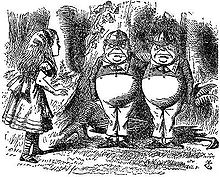
There is an old joke about politics. Elections are about choosing between "Tweedle Dum and Tweedle Dummer." (originally it was Tweedledee and Tweedledum, John Tenniel's illustration, from Through the Looking-Glass (1871)). Of course nobody in national politics is dum anymore. even if they are, brains can easily be hired. It seems that now the choice if often between Tweedle Bad and Tweedle worse. Deciding who is Bad and who is Worse is a matter of nuance. Answers to basic questions like those above are going to inform that choice. Good people will disagree.

Two more things, really quick:
Nobody wants to make an important decision based on 50.0001% certainty. In the same way that a fisherman's fish gets bigger each time he tells about his catch, decisions that barely more than a coin-toss to begin with, evolve into thunderous slam-dunks. Our craving for certitude drives us in that direction.
When our certitude is challenged we easily become like a potential mugging victim cornered in a dark alley. 2x4, rock, broken bottle, we desperately look for a weapon we can use in self-defense. In  the kind of fight this article is about, there is almost always piece of pipe nearby. It is about 2 feet long and has fitting on one end. Read the label--ad hominem, attack the spokesperson rather than what the spokesperson says.

In this case the spokesperson is me, so be nice. Chew on this until next time.
it