Me with my lovely wife, Kathy:
Showing posts with label Trump. Show all posts

Monday, December 23, 2019

Can We Just All Get Along? Part 1:

Mark Galli, Franklin Graham, and some friends of mine:
I realize that by writing this, I'm taking the role of someone who steps into a domestic dispute. Before I'm done both sides might decide to unite and fight with me rather than each other. I'm motivated to stick my nose in, however, because this is a squabble that is taking place between my friends. Though I've never met either, I regard both Mark Galli and Franklin Graham as friends. I have benefitted from both of their ministries. As soon as the matter hit the fan, so to speak, some of my personal friends began to weigh in. I felt like the host at a Thanksgiving feast when war-veteran Uncle Charlie, just couldn't resist commenting on Niece Suzie's "I love Jane Fonda" sweatshirt and the vegan meal she had packed in for the occasion.
At first, I thought I would write one big peace-making piece. Instead, I'm going to dole out my "wisdom" in bite-size servings. That way you can chew on each serving for a day or two before the next mouthful is served up.
Before I offer my first pacific hors d'oeuvres (note that's a lower-case "p"), let me review what I'm talking about.

  • On December 19, Editor Mark Galli published an editorial in Christianity Today stating, "Whether Mr. Trump should be removed from office by the Senate or by popular vote next election—that is a matter of prudential judgment. That he should be removed, we believe, is not a matter of partisan loyalties but loyalty to the Creator of the Ten Commandments."
  • Whatever is you may think of Galli--I have found him to be often helpful in pulling together various strands of thought in the Christian world--he is no dummy. I'm not saying that it was Galli's intention to stir up a ruckus with his frequent use of CT founder, Rev. Billy Graham's, name, but he had to have known that using Graham's name in this context could be seen as waving a red cape in front of a bull named Franklin.
  • Franklin Graham, Billy's son, did not disappoint. He released a statement the next day. To no one's surprise, he disagreed with Galli. He did surprise some of us, though, when he revealed that his dad had voted for Mr. Trump.
  • I have no idea how many opinion pieces followed. I saw several articles about an interview Galli did on CNN. Another article is a summary of an interview Galli had with New Yorker writer, Isaac Chotiner.
  • Nothing much happens in our world without a petition or letter to sign. Not to disappoint, more than one-hundred Evangelical leaders signed a letter addressed to CT President Timothy Dalrymple. “Your editorial offensively questioned the spiritual integrity and Christian witness of tens-of-millions of believers who take seriously their civic and moral obligations.”
  • Of course, Dalrymple responded, and 
  • on it goes.

Let's begin by thinking about worldviews--perhaps philosophies or even Theologies are better words. What I'm talking about are those foundational truths on which we build the rest of our thinking. Our overall philosophy of life and our ethics which are part of that philosophy are based on the way we see the world. What makes the world tick? Or, perhaps more accurately, "What would make our world work the way it should?"
Since all Evangelicals, to one extent or another, hold in common the basic Gospel message of the death, burial, and resurrection of Christ and all that these fact mean, one would think that Evangelicals share the same worldview. One might think that, but one might be wrong. The Roman Catholic Church and the early reformers all subscribed to the same creeds, yet their differences fomented reformations, martyrdoms, and wars. The varying denominations in Christendom bear witness not to what they shared, but to that over which they differed.
The operative question is often not just, "What do you think is important? but, "What do you think is most important at this time, and how does that differ from what your neighbor thinks?"
Take the present bruhaha and dig down to the basic realities--as each side sees them--that lie below the surface. Here are two matters that both sides agree on, in principle, but about which they disagree mightily in degree and emphasis--abortion and social justice. Keeping our focus on the evangelical leaders who are in this argument, it is clear that both sides are prolife. Just reading the articles I mentioned above will make that clear. Once you get below that agreement in principle, however, we notice all sorts of differences. Is this the most important issue of our day? Is it so important that someone who is not prolife disqualifies themself as being worthy to hold public office? What about prenatal deformities, rape, or incest? How do we define "health of the mother"? What difference does the answer make?
Galli's writing and Graham's humanitarian work clearly show both to be dedicated to social justice. Just exactly how does one best address life's inequities? To what extent do people today have a responsibility to repair the social legacy of their less enlightened ancestors?
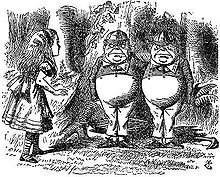
There is an old joke about politics. Elections are about choosing between "Tweedle Dum and Tweedle Dummer." (originally it was Tweedledee and Tweedledum, John Tenniel's illustration, from Through the Looking-Glass (1871)). Of course nobody in national politics is dum anymore. even if they are, brains can easily be hired. It seems that now the choice if often between Tweedle Bad and Tweedle worse. Deciding who is Bad and who is Worse is a matter of nuance. Answers to basic questions like those above are going to inform that choice. Good people will disagree.

Two more things, really quick:
Nobody wants to make an important decision based on 50.0001% certainty. In the same way that a fisherman's fish gets bigger each time he tells about his catch, decisions that barely more than a coin-toss to begin with, evolve into thunderous slam-dunks. Our craving for certitude drives us in that direction.
When our certitude is challenged we easily become like a potential mugging victim cornered in a dark alley. 2x4, rock, broken bottle, we desperately look for a weapon we can use in self-defense. In  the kind of fight this article is about, there is almost always piece of pipe nearby. It is about 2 feet long and has fitting on one end. Read the label--ad hominem, attack the spokesperson rather than what the spokesperson says.

In this case the spokesperson is me, so be nice. Chew on this until next time.
it

Tuesday, June 4, 2019

Praying for the President: Should I, Would I?

A neighboring pastor, Jerry Fallwell Senior, used to say that people in Lynchburg VA would either pucker (as in to kiss) or spit when they saw him coming. Clearly, our current President, Donald Trump, brings out those kinds of polar responses in the political social realm. I'll leave it to others to sort out which pole, or perhaps a mediating view, is right about the current resident of the White House. My thought today has to do with an interesting encounter another Virginia pastor had with Mr. Trump.
At this point, I'll quote from Tim Challies's blog. I had heard about Trump appearing before a church asking for prayer. It was Challies who provoked me to click and learn more.
PRAYER FOR THE PRESIDENTDavid Platt explains how he found himself praying for President Trump on Sunday morning. “Sometimes we find ourselves in situations that we didn’t see coming, and we’re faced with a decision in a moment when we don’t have the liberty of deliberation, so we do our best to glorify God. Today, I found myself in one of those situations.”
Platt found himself in a very typical pastoral situation, not that the President regularly appears in a church requesting prayer, but pastors frequently find themselves in situations when they have to make potentially important--even life-altering decisions in a very brief time. I have often been in these Nehemiah moments. You remember, don't you, when Nehemiah stood before the absolute sovereign of Persia. In the sycophantic culture of the palace, Nehemiah had been caught in what could be a capital crime. “Why is your face sad, seeing you are not sick?" (Nehemiah 2:2) Sadness in the monarch's presence was considered an insult. Nehemiah bravely summarized the source of his discomfort, the plight of his people, the Jews, who lived on the fringe of the Persian kingdom. I figure Nehemiah's senses must have been on high alert. The plight of his people was the result of the policy and practice of the Persian administration, and he was standing before the Supreme Persian. Nehemiah's relief at not being immediately dragged away was short-lived.
Then the king said to me, “What are you requesting?”" (2:4)
In that brief moment--that was all he had--Nehemiah prayed.
I figure Platt uttered one of those "Help, Lord!" prayers as he decided how to handle the request put before him. President Trump had shown up, unannounced, toward the end of a service, and requested that the McLean Bible Church have a time of public prayer for him. (It would appear from the report that the President's request was not disruptive--at least not to those other than Pastor Platt.)
I've not made requests before all-powerful Kings or had the controversial President of my nation appear at a service requesting prayer. I have, many, many times found myself in situations when I needed to decide fairly quickly, knowing that the decision wasn't completely black or white and/or knowing that either way I decided there would be consequences, some negative. Just off the top of my head here are some. Fellow pastors will note, "been there, decided that."

  • Phone call from a funeral director: "Rev. Merrell, The family of Sally Jones has asked that you speak at her funeral." At this point the default, "Yes, of course." answer is on my lips. "Oh, and by the way Rev. Objectionable will also be speaking." Fill in the blank. Rev. Objectionable is a heretic, sexually immoral person, member of a group that is Theologically obnoxious, or someone who has instulted me and my church, etc.
  • Walking into a hospital room of a person who has been diagnosed with a terminal disease. The family has been diagnosed with a sickness called "denial." In hushed tones they instruct me, "Don't mention that she has cancer." 
  • In spite of my best efforts to set up policies and guidelines, someone or something comes along that doesn't quite fit what I had already decided. As I make up my mind I can already hear the protests, "But you didn't do that for . . ." The nuance that influenced my spur of the moment decision would be lost on my detractors.
  • I wish I could more consistently take comfort in the knowledge that our Lord suffered at the hands of critics. "He hangs out with tax-collectors and prostitutes." Too frequently, my thoughts continue, "Yes, and they crucified Him."
I could go on, but I think I have made the point, at least one point, of this post. Church-member, your pastor is called on to make decisions that you will never have to make and often make those choices in a Nehemiah moment. Cut him some slack. More importantly, pray for him.

For what it is worth, I think Platt made the right decision. He probably won't read this, but I figure I ought to stick up for someone who is making a good effort to do the right thing in a turblent context. To those who think otherwise, I ask you to consider, would your objection still be there if the President were Mrs. Clinton, Mr. Sanders, or (fill in the blank with your favorite)?

I also was convicted by the news. I find it difficult to consistently pray for my leaders. Often mention of "Kings and all who are in high places" in my public prayers are most prominent by their absence. I need to do better.

Below is the link to a post in which Pastor Platt shares his thoughts. It concludes with a video of him praying for President Trump.


BTW, a word of thanks to Denise Gregson for giving me a heads up about Tim Challies post. :)

Wednesday, November 9, 2016

A Historic Election: Now What?

In our nation this morning, you can hear a collective “Wow!” 

"The most stunning political upset in American history."
That's how ABC News commentator George Stephanopoulos described Donald Trump's victory.

One commentator speaking about how we—the talking heads on TV—got it so wrong, said, “Pollilng broken.”  Indeed as we look at not only the two candidates in this contentious campaign, but the methodology behind them, it shows clearly that, in spite of our best efforts, we are not nearly so in control as we would like to think.  The losing campaign was powered by an incredibly sophisticated data-driven, computer aided, algorithm guided, scientific process.  The winning campaign was run by a man’s gut.  (No pun intended, but if a bit of humor helps, go with it.)  It kind of reminds me of the John Henry statue a few miles from where I sit.  On this night, man beat machine.  Since most of us had already accepted that the machine couldn’t be beaten, we find it a bit un-nerving.
Just this past Monday I was talking to a fellow pastor.  Like me, he sees the man who is now our President-elect as a flawed individual.  He articulated his support, not of this candidate, but of the platform that he represents.  He articulated why he would vote for Donald Trump.  He articulated about seven points—prolife concerns, gender issues, a desire to see a proper respect for law, etc.—all had to do with matters concerning which God’s word speaks; none had to do with prejudice or ill-will toward any group of people.  My friend wanted the outcome that has come to pass, but toward the end of our conversation he said, “I really feel that Secretary Clinton is going to win.”  Then there are those who were so invested in a Clinton-Kaine victory that they couldn’t imagine any other outcome.  As I listen to the morning-after commentary words like shock, seismic, bomb-shell, and greatest-upset dominate the reports.  How should we as God’s people be God’s people in this critical time?
From my position I heard from fellow-Christians over the past few months who were, on the one hand, clearly in favor of a Trump victory, and other—equally Godly, in-love-with-Jesus—sisters and brothers who rather passionately were opposed.  Many of my friends concluded that they could vote for neither of the two leading candidates.  I won’t be surprised to find out that my name was written-in somewhere.  Because of the computer-driven ability to track and crunch numbers, we not only know the big, important, number—who has the most Electoral College votes—but all kinds of other statistics.  As a result we see the deep divisions that exist within our nation more clearly than ever.  There is a knee-jerk reaction to this kind of shocking outcome.  On the one hand those on the winning side can have a tendency to look at those groups who “opposed this historic victory” and seek ways to make them pay.  On the other hand, it is easy for those who did not win the day to be on the “See, I told you so.” watch.  A recent “60 Minutes” piece fleshes out the observation that 82% of Americans were disgusted with the recent political campaign.  (I warn you, in speaking frankly, some of the folk in this focus group express themselves using words of which I don’t approve.)  Frank Luntz’s words, especially what he said at the end of the piece, are worth considering.  Far more eloquent than the pollster, are the words of Abraham Lincoln at his second inaugural.

“With malice toward none, with charity for all, with firmness in the right as God gives us to see the right, let us strive on to finish the work we are in, to bind up the nation's wounds, to care for him who shall have borne the battle and for his widow and his orphan, to do all which may achieve and cherish a just and lasting peace among ourselves and with all nations” (Lincoln).

This is true about us as a nation.  It is absolutely indisputable for us who are part of the body of Christ.  Many of us—others with far more eloquence than me--have said for months, now, that we need to remember—no, we need to militantly cling to the reality—that all of us who by God’s grace have been made new creatures in Christ have something in common that supersedes anything that might divide us.  Scott McKnight, on this historic morning, stood to lead us in prayer.  I encourage you to join him.
There is a low spot in the bed.  Unless we resist we’ll roll into it.  The tendency is abundantly clear in the 60 Minutes excerpt above.  We tend to look for what is worst in the motives of those on the other side.  I heard it come out clearly in some of the comments that were made by dedicated Hillary/Kaine supporters as it became clear that they were not going to win the day.  “I guess there are more people who support bigotry and xenophobia, than there are who support the dignity of all people”  (That is not an exact quotation, but an honest attempt to capture what I heard.).  I know John MacArthur is, himself, a polarizing person.  I ask you to set that aside for a moment.  I was surprised that he spoke with a clarity with which I was not comfortable, even as a former pastor.  He does, however, articulate the carefully parsed reasoning that entered into not only his decision, but a great many Christians’.  I don’t doubt that such people are out there, but I will say clearly that I did not hear any supporters say anything remotely like, “I support Donald Trump because I hate ______,” or, “because I want to see ______, put down, discriminated against, etc.”  Likewise I heard none of the Hillary/Kaine supporters say, “I want to kill babies.”  Sure, the ideas that each candidate espoused—indeed, the ideas that motivate each of us—have consequences, and it is entirely appropriate for us to point where the way one thinks leads, it is, however, very important that we avoid rhetoric that enflames, and rather seek to engage in conversation that enlightens.

“Let your speech always be gracious, seasoned with salt,
 so that you may know how you ought to answer each person”
 
(Col 4:6, ESV).

Let’s be careful about how we talk in the days ahead.  Like David, let’s pray that God will guard our speech.  “Set a guard, O LORD, over my mouth; Keep watch over the door of my lips” (Psalm 141:3)
Let me again quote from our Sixteenth president.

“Both read the same Bible and pray to the same God, and each invokes His aid against the other. It may seem strange that any men should dare to ask a just God's assistance in wringing their bread from the sweat of other men's faces, but let us judge not, that we be not judged. The prayers of both could not be answered. That of neither has been answered fully. The Almighty has His own purposes.” 

God has His own purposes, and, I add, His purposes are not necessarily ours, and we don’t have them figured out.  (Read Romans 11:34-36.)
Let me close what is a fairly gloomy post with an invitation to watch a beautiful sunrise.  No, what I speak of has nothing to do with which candidate or which party prevailed yesterday; it has to do with the end of the Bible.  I read the end of the book, and God wins.  This is one of those times when it is easier than on other occasions to believe God’s sovereignty.  I find myself clinging to that reality, this morning, like a person grasps a piece of flotsam after a shipwreck. 

Hold on tightly, child of God.  He will not forsake His own.