I don't remember whether it was Twilight Zone, Outer Limits, or some other show along that line, but I do remember the basic plot device of an episode. Two opposing groups were locked in deadly warfare. The story focused on one group "protecting" some important facility. Part of the soldier's training was that they were to wear this protective visor at all times. This would protect them from some blinding weapon that the enemy had.
The kick-in-the-gut ending came when some soldier lost his visor and found out that the hideous, insect-like creatures he had been killing in order to save his kind, were, in reality, people like himself.
Unfortunately, the syndrome happens in reality--sans special eyewear--all the time. I call it the "Other Syndrome." ( I don't think that is original with me.) If we see someone with whom we disagree as fundamentally other than we are, our tendency is to not treat them with the respect they deserve. I'll not supply any general examples, though they abound. Stop and think for a minute and come up with your own.
Specifically, the current divide among Evangelicals concerning President Trump is riff with the Other Syndrome. From Hilary Clinton's "Basket of Deplorables," to right-wing commentators who ridicule the left, to Galli's claim to be an elite Evangelical, to those who doubt the salvation of those on the other side, it is clear that one reason we can't have a civil discussion is we not only disagree with our opponents, too often we don't consider them worthy of civil discourse. I'm not saying there aren't real differences. There are. I'm saying we often don't treat others with respect, even in the church.
Let me illustrate the concept based on the politics/culture of the little city where I spent most of my adult life. In the 70s when I moved to the paper mill town where I ministered, there was plenty to argue about, but there was a certain level of civility as well. Mill managers and laborers had children who attended the same schools and played on the same sports teams. Often management and union members attended the same churches and ate at the same restaurants. One sat at a desk, the other carried a lunch box, but there was an awareness that in significant ways, "we are the same." In the last couple of decades, a "Brain-drain changed the character of things. The higher-level management no longer lived in our little town. They commuted in from 50 miles away. Doctors, lawyers, and even school teachers followed suit. It became easier to think of the other side as OTHERs, not like me. The community suffers because of that.
This is a bad thing in society in general. Within the church it is horrible. The fact that I always need to bring to the table is that any difference I have with a fellow believer pales in significance when I consider the sameness we have in Christ.
Lord, help me to think about that before I speak, write, or post.

Me with my lovely wife, Kathy:
Thursday, December 26, 2019


Monday, December 23, 2019
Can We Just All Get Along? Part 1:
Mark Galli, Franklin Graham, and some friends of mine:
I realize that by writing this, I'm taking the role of someone who steps into a domestic dispute. Before I'm done both sides might decide to unite and fight with me rather than each other. I'm motivated to stick my nose in, however, because this is a squabble that is taking place between my friends. Though I've never met either, I regard both Mark Galli and Franklin Graham as friends. I have benefitted from both of their ministries. As soon as the matter hit the fan, so to speak, some of my personal friends began to weigh in. I felt like the host at a Thanksgiving feast when war-veteran Uncle Charlie, just couldn't resist commenting on Niece Suzie's "I love Jane Fonda" sweatshirt and the vegan meal she had packed in for the occasion.
At first, I thought I would write one big peace-making piece. Instead, I'm going to dole out my "wisdom" in bite-size servings. That way you can chew on each serving for a day or two before the next mouthful is served up.
Before I offer my first pacific hors d'oeuvres (note that's a lower-case "p"), let me review what I'm talking about.
Let's begin by thinking about worldviews--perhaps philosophies or even Theologies are better words. What I'm talking about are those foundational truths on which we build the rest of our thinking. Our overall philosophy of life and our ethics which are part of that philosophy are based on the way we see the world. What makes the world tick? Or, perhaps more accurately, "What would make our world work the way it should?"
Since all Evangelicals, to one extent or another, hold in common the basic Gospel message of the death, burial, and resurrection of Christ and all that these fact mean, one would think that Evangelicals share the same worldview. One might think that, but one might be wrong. The Roman Catholic Church and the early reformers all subscribed to the same creeds, yet their differences fomented reformations, martyrdoms, and wars. The varying denominations in Christendom bear witness not to what they shared, but to that over which they differed.
 The operative question is often not just, "What do you think is important? but, "What do you think is most important at this time, and how does that differ from what your neighbor thinks?"
Take the present bruhaha and dig down to the basic realities--as each side sees them--that lie below the surface. Here are two matters that both sides agree on, in principle, but about which they disagree mightily in degree and emphasis--abortion and social justice. Keeping our focus on the evangelical leaders who are in this argument, it is clear that both sides are prolife. Just reading the articles I mentioned above will make that clear. Once you get below that agreement in principle, however, we notice all sorts of differences. Is this the most important issue of our day? Is it so important that someone who is not prolife disqualifies themself as being worthy to hold public office? What about prenatal deformities, rape, or incest? How do we define "health of the mother"? What difference does the answer make?
Galli's writing and Graham's humanitarian work clearly show both to be dedicated to social justice. Just exactly how does one best address life's inequities? To what extent do people today have a responsibility to repair the social legacy of their less enlightened ancestors?
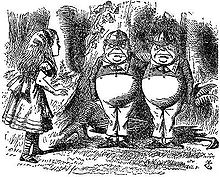 There is an old joke about politics. Elections are about choosing between "Tweedle Dum and Tweedle Dummer." (originally it was Tweedledee and Tweedledum, John Tenniel's illustration, from Through the Looking-Glass (1871)). Of course nobody in national politics is dum anymore. even if they are, brains can easily be hired. It seems that now the choice if often between Tweedle Bad and Tweedle worse. Deciding who is Bad and who is Worse is a matter of nuance. Answers to basic questions like those above are going to inform that choice. Good people will disagree.
Two more things, really quick:
Nobody wants to make an important decision based on 50.0001% certainty. In the same way that a fisherman's fish gets bigger each time he tells about his catch, decisions that barely more than a coin-toss to begin with, evolve into thunderous slam-dunks. Our craving for certitude drives us in that direction.
When our certitude is challenged we easily become like a potential mugging victim cornered in a dark alley. 2x4, rock, broken bottle, we desperately look for a weapon we can use in self-defense. In the kind of fight this article is about, there is almost always piece of pipe nearby. It is about 2 feet long and has fitting on one end. Read the label--ad hominem, attack the spokesperson rather than what the spokesperson says.
In this case the spokesperson is me, so be nice. Chew on this until next time.
it
I realize that by writing this, I'm taking the role of someone who steps into a domestic dispute. Before I'm done both sides might decide to unite and fight with me rather than each other. I'm motivated to stick my nose in, however, because this is a squabble that is taking place between my friends. Though I've never met either, I regard both Mark Galli and Franklin Graham as friends. I have benefitted from both of their ministries. As soon as the matter hit the fan, so to speak, some of my personal friends began to weigh in. I felt like the host at a Thanksgiving feast when war-veteran Uncle Charlie, just couldn't resist commenting on Niece Suzie's "I love Jane Fonda" sweatshirt and the vegan meal she had packed in for the occasion.
At first, I thought I would write one big peace-making piece. Instead, I'm going to dole out my "wisdom" in bite-size servings. That way you can chew on each serving for a day or two before the next mouthful is served up.
Before I offer my first pacific hors d'oeuvres (note that's a lower-case "p"), let me review what I'm talking about.
- On December 19, Editor Mark Galli published an editorial in Christianity Today stating, "Whether Mr. Trump should be removed from office by the Senate or by popular vote next election—that is a matter of prudential judgment. That he should be removed, we believe, is not a matter of partisan loyalties but loyalty to the Creator of the Ten Commandments."
- Whatever is you may think of Galli--I have found him to be often helpful in pulling together various strands of thought in the Christian world--he is no dummy. I'm not saying that it was Galli's intention to stir up a ruckus with his frequent use of CT founder, Rev. Billy Graham's, name, but he had to have known that using Graham's name in this context could be seen as waving a red cape in front of a bull named Franklin.
- Franklin Graham, Billy's son, did not disappoint. He released a statement the next day. To no one's surprise, he disagreed with Galli. He did surprise some of us, though, when he revealed that his dad had voted for Mr. Trump.
- I have no idea how many opinion pieces followed. I saw several articles about an interview Galli did on CNN. Another article is a summary of an interview Galli had with New Yorker writer, Isaac Chotiner.
- Nothing much happens in our world without a petition or letter to sign. Not to disappoint, more than one-hundred Evangelical leaders signed a letter addressed to CT President Timothy Dalrymple. “Your editorial offensively questioned the spiritual integrity and Christian witness of tens-of-millions of believers who take seriously their civic and moral obligations.”
- Of course, Dalrymple responded, and
- on it goes.
Let's begin by thinking about worldviews--perhaps philosophies or even Theologies are better words. What I'm talking about are those foundational truths on which we build the rest of our thinking. Our overall philosophy of life and our ethics which are part of that philosophy are based on the way we see the world. What makes the world tick? Or, perhaps more accurately, "What would make our world work the way it should?"
Since all Evangelicals, to one extent or another, hold in common the basic Gospel message of the death, burial, and resurrection of Christ and all that these fact mean, one would think that Evangelicals share the same worldview. One might think that, but one might be wrong. The Roman Catholic Church and the early reformers all subscribed to the same creeds, yet their differences fomented reformations, martyrdoms, and wars. The varying denominations in Christendom bear witness not to what they shared, but to that over which they differed.
Take the present bruhaha and dig down to the basic realities--as each side sees them--that lie below the surface. Here are two matters that both sides agree on, in principle, but about which they disagree mightily in degree and emphasis--abortion and social justice. Keeping our focus on the evangelical leaders who are in this argument, it is clear that both sides are prolife. Just reading the articles I mentioned above will make that clear. Once you get below that agreement in principle, however, we notice all sorts of differences. Is this the most important issue of our day? Is it so important that someone who is not prolife disqualifies themself as being worthy to hold public office? What about prenatal deformities, rape, or incest? How do we define "health of the mother"? What difference does the answer make?
Galli's writing and Graham's humanitarian work clearly show both to be dedicated to social justice. Just exactly how does one best address life's inequities? To what extent do people today have a responsibility to repair the social legacy of their less enlightened ancestors?
There is an old joke about politics. Elections are about choosing between "Tweedle Dum and Tweedle Dummer." (originally it was Tweedledee and Tweedledum, John Tenniel's illustration, from Through the Looking-Glass (1871)). Of course nobody in national politics is dum anymore. even if they are, brains can easily be hired. It seems that now the choice if often between Tweedle Bad and Tweedle worse. Deciding who is Bad and who is Worse is a matter of nuance. Answers to basic questions like those above are going to inform that choice. Good people will disagree.Two more things, really quick:
Nobody wants to make an important decision based on 50.0001% certainty. In the same way that a fisherman's fish gets bigger each time he tells about his catch, decisions that barely more than a coin-toss to begin with, evolve into thunderous slam-dunks. Our craving for certitude drives us in that direction.
When our certitude is challenged we easily become like a potential mugging victim cornered in a dark alley. 2x4, rock, broken bottle, we desperately look for a weapon we can use in self-defense. In the kind of fight this article is about, there is almost always piece of pipe nearby. It is about 2 feet long and has fitting on one end. Read the label--ad hominem, attack the spokesperson rather than what the spokesperson says.
In this case the spokesperson is me, so be nice. Chew on this until next time.
it
Friday, December 20, 2019
The Wonder of Christmas, Don't Just Ooh and Aah. Live it.
Merry Christmas!
There is a tendency we humans have. It is often called "compartmentalization."
 We have an ability to take certain thoughts, memories, and experiences and put them in a mental room--a place in our mind that we keep separate from everything else. I see moms do this when they suffer from some physical pain, yet wall that off from their everyday life in which they cook, clean, and make life good for the rest of us. We might say that kind of compartmentalization is good. Sometimes I have to deal with people I don't like. I need to keep my feelings separate from my need to do my job. I need to remember however that these compartments are never completely leak-proof. Big problems come when we attempt to compartmentalize issues that should be addressed and solved. This is especially true when we attempt to compartmentalize that which is explosive or corrosive. It will eventually get out.
But my purpose, today, isn't to talk about counseling.
I observed in my pastoral ministry a tendency to compartmentalize when it comes to Theological truth. Now that I'm involved in Christian education, I am even more prone to build rooms in my
 mind. "This is my Theological Truth Room. In this room, I believe that God is Lord. He is to be obeyed. I believe that all humans are created in God's image and are to be treated with honor, respect, and kindness. In my Theological Truth Room, I can tell you about inspiration and how the Bible is truly God's word.
I have the ability, however, to step outside of my Theological Truth Room and live the rest of my life as if none of that is true.
Two things, I've read recently remind me of my tendency to compartmentalize Theological truth. One of them is a well-written 3-part series about the wonderful Theological truth we celebrate at Christmas. The other is a practical reminder I received from a missionary colleague.
"Tried With Fire: Like Jesus," by Kevin Bauder (Scroll down at the site and start with Part 1) takes on the difficult subject of the nature of Christ, the hypostatic union, the kenosis, in plain terms--the wonder of Christmas. The nature of the God-Man, Jesus Christ is at the heart of our faith. It is also at the fringe, or just beyond the edge of what we can comprehend. There is good reason that this truth occupied the best minds of early Christian history. It is a key part of our view of the Triune God. This saying that is frequently quoted about the doctrine of the Trinity, applies to the nature of Christ, as well..
The Trinity:
Try to Understand It
and You’ll Lose Your Mind.
Try to Deny It
and You’ll LOSE YOUR SOUL!
(As a side-note, Fred Sanders has an interesting article on this, in which he says we don't know who said it first .)
Getting back to my main point, however, Bauder reminds us, referring to Philippians 2, that the wonder of the incarnation is not a Theological pearl to store away in the Theological Truth Room of my mind. It is a reality that should inform every aspect of my life. The way of thinking that led to God the Son's humiliation, should be my way of thinking. If Christ was willing to lay aside His honor for the sake of others (John 17, Phil. 2), then who do I think I am, when I claim that, or act as if, serving others is somehow beneath me?
Getting back to my main point, however, Bauder reminds us, referring to Philippians 2, that the wonder of the incarnation is not a Theological pearl to store away in the Theological Truth Room of my mind. It is a reality that should inform every aspect of my life. The way of thinking that led to God the Son's humiliation, should be my way of thinking. If Christ was willing to lay aside His honor for the sake of others (John 17, Phil. 2), then who do I think I am, when I claim that, or act as if, serving others is somehow beneath me?
The truth of Christmas should not be remembered just during a certain season. Rather like the frankincense the wise men presented to Christ, gave a smell that permeated every part of the house, all my life should be informed by this sublime reality. I should not only proclaim with wonder that "God became man." I should live a life that is an appropriate response to the incarnation. I should live in the "Therefore" of Romans 12:1.
A friend is a missionary with another agency and a part of my Guam Church.
She and her husband are on furlough, a strange (to others) part of the missionary occupation that involves visiting supporters. She writes:
She and her husband are on furlough, a strange (to others) part of the missionary occupation that involves visiting supporters. She writes:
Last Saturday, we spent part of the day with [some folk they know from the past at our Church]. They asked about many of you and send their greetings. At lunch they were telling one of their sons and his wife about their first Sunday at [our Church]. Right after the service, [a couple from our church] invited them to lunch at a restaurant. The [couple] didn't know them. The [visitors] felt so welcomed at [our] Church that they decided not to look anywhere else for a home church. So once again everyone can see how important is for everyone in our church [or any church, or a small Christian university] to do their part to make visitors feel welcomed.
What this couple did for some visitors to their church has a direct relationship to the wonder we celebrate at Christmas. Why should I spend my time and money on strangers? I might not even like them.
Why? because of what Jesus did for us. As the Apostle John puts it, so succinctly, "We love because He first loved us" (1 John 4:19).
Open the door, let the wonder of Christmas spread through all your life. It is a truth too wonderful to keep in just one room.
Merry Christmas!
Wednesday, November 6, 2019
Some Missionary Thoughts That Might Prove Helpful
Over at another blog I posted something that might be of use to pastors and/or folk who serve on missions committees, etc.
Here it is.
Here it is.
Tuesday, October 1, 2019
Psalms of Confidence: Do you really believe what you say you believe?
Sunday, I had the privilege of teaching Sunday School at Faith Presbyterian Christian Reformed Church, our church, here, on Guam. We are doing a study on the Book of Psalms. Sunday's class was built around a video of a lecture on Psalm 11 delivered, by Dr. Godfrey at Ligonier Fellowship. If you are interested you can purchase the video from Ligonier.
You can read Psalm 11 here.
As is often the case, I didn't get done with what I hoped to say. In case any of my classmates are interested in some follow-up and for the benefit of all, here is some of what remained on my iPad at the end of class.
Psalm 11is according to The Light of the Psalms, by Michael Ross, a “Psalm of Trust.” He identifies six other Psalms as Psalms of trust, or as they are sometimes called Confidence Psalms.
Psalms 11, 16, 23, 27, 63, 73, and 91 all begin with a basic Theological truth about God. These are concepts that we don't have trouble affirming when the sun is shining. When the dark clouds of life roll in, however, we tend to say, "Maybe not today." In brief, bullet-point fashion, here are the realities about God found in the opening statements of these Psalms of Trust.
Perhaps at the beginning of these trust Psalms, we could accuse the writers of whistling in the dark. By the end, though, they have wrestled in the mud with demons within and without. Each of these Psalms ends with triumphant confidence.
You can read Psalm 11 here.
As is often the case, I didn't get done with what I hoped to say. In case any of my classmates are interested in some follow-up and for the benefit of all, here is some of what remained on my iPad at the end of class.
Psalm 11is according to The Light of the Psalms, by Michael Ross, a “Psalm of Trust.” He identifies six other Psalms as Psalms of trust, or as they are sometimes called Confidence Psalms.
Psalms 11, 16, 23, 27, 63, 73, and 91 all begin with a basic Theological truth about God. These are concepts that we don't have trouble affirming when the sun is shining. When the dark clouds of life roll in, however, we tend to say, "Maybe not today." In brief, bullet-point fashion, here are the realities about God found in the opening statements of these Psalms of Trust.
- Psalm 11, begins with the Lord as David's refuge. That thought also is part of the opening of Psalms 16, and 91. In 27 we find a similar word, "stronghold." When I checked, I saw that the alternative translation is "refuge."
- Psalm 16:8 is a deliberate action. It is the kind of response Col. 3:1 calls for, "seek the things above." David makes the Lord the center of his thoughts, as his descendant would later command. "Seek first the kingdom of God."
- Psalm 23, the most familiar of the Psalms begins with the comforting truth, "The Lord is Shepherd." It goes on to enumerate the benefits that come to a sheep in His flock.
- Psalm 27, is a vastly different picture from the pastoral scene of the Shepherd Psalm. God is my stronghold, my defense.
- When David looks at God in Psalm 63, he sees him as "My God." He is not just an abstract concept. David longs for God. God is personal. David's relationship with Him is a personal relationship.
- I call Psalm 73 one of the "slippery place" Psalms. Asaph is desperately holding on to the truth, "Surely God is good to Israel, To those who are pure in heart!"
- Psalm 91 begins with a summary of what we have already seen. The Psalmist begins with a combination of military security and personal trust.
It's in verse 4 of Psalm 11 that David anchors his soul. As in a concert the momentary dissonance draws attention to the resolution when it comes. In these Psalms the present reality--honestly, even brutally expressed--provides the dark background that shows the brilliance of the truth even more vividly.
- In spite of what's going on right now, the "Lord is in His holy temple." Ps 11
- The "Lord is my chosen portion." Ps 16
- The shadow of death and the evil around me are no match for the Shepherd's rod and staff. Ps 23
- David's confidence is not because of, but in spite of his circumstances. Ps 27
- Like the Apostle Paul a millennium later, David does the arithmatic. "Your lovingkindness is better than life." Ps 63 & Phil 1:21
- In Psalm 91 is extravagant in it's reassurance. It is like a crecendoing tympany that keeps on rising.
- Psalm 73 is my personal favorite, for putting things right. The hinge-pin of the Psalm is a trip to the sanctuary (73:17). True worship is therapeutic. It sets the bones of our soul straight.
Perhaps at the beginning of these trust Psalms, we could accuse the writers of whistling in the dark. By the end, though, they have wrestled in the mud with demons within and without. Each of these Psalms ends with triumphant confidence.
“For the Lord is righteous; he loves righteous deeds; the upright shall behold his face.” (Psalm 11:7, ESV)
“You make known to me the path of life; in your presence there is fullness of joy; at your right hand are pleasures forevermore.” (Psalm 16:11, ESV)
“Surely goodness and mercy shall follow me all the days of my life, and I shall dwell in the house of the Lord forever.” (Psalm 23:6, ESV)
“I believe that I shall look upon the goodness of the Lord in the land of the living! Wait for the Lord; be strong, and let your heart take courage; wait for the Lord!” (Psalm 27:13–14, ESV)
“But those who seek to destroy my life shall go down into the depths of the earth; they shall be given over to the power of the sword; they shall be a portion for jackals. But the king shall rejoice in God; all who swear by him shall exult, for the mouths of liars will be stopped.” (Psalm 63:9–11, ESV)
“Whom have I in heaven but you? And there is nothing on earth that I desire besides you. My flesh and my heart may fail, but God is the strength of my heart and my portion forever.” (Psalm 73:25–26, ESV)
"I will . . . show him My salvation." (Psalm 91:16)
God is Who He says He is. Go live like it.
Tuesday, September 17, 2019
Redecoration, A Model of Excellence
My lovely wife, Kathy, just finished, at least mostly finished, a redecorating of the President's office. She wants me to have a nice place to work. I am grateful. It is a pleasant place to do what I need to
 do, and a comfortable place to meet with visitors.
The furniture was a gift from a member of our "Guam church." The plan came from Kathy and a colleague of mine, here, at PIU. In the picture to the right, my Virginia home is on the left panel and my new, Guam home is on the far right.
The wall next to my desk has pictures of family and a copy of my "Delivery Business" saying. The greenery is something that grows in the yard.

Most of my books are digital. Some are still in Virginia.
The shelf has a few text books, some books I have rescued from a library sale & various mementos, some left by the previous president, Dave Owen. I keep the three hats on the top to remind me that I need to be flexible--wear different hats--and because it saves closet space at home. :)


This (left) gives you an idea of the area where I sit. I'm using the desktop computer, on the little table, right now. My laptop sits on the desk.
More greenery in the corner (below).

 The diploma from Liberty Seminary and the window treatment, Kathy made, remind me of an old song. It was the theme to a John Wayne movie. Anyone remember?


Our emphasis, this year at PIU is on excellence. Whatever we do, we should seek to do it with excellence so we can glorify our Great God.


The furniture was a gift from a member of our "Guam church." The plan came from Kathy and a colleague of mine, here, at PIU. In the picture to the right, my Virginia home is on the left panel and my new, Guam home is on the far right.
The wall next to my desk has pictures of family and a copy of my "Delivery Business" saying. The greenery is something that grows in the yard.

Most of my books are digital. Some are still in Virginia.
The shelf has a few text books, some books I have rescued from a library sale & various mementos, some left by the previous president, Dave Owen. I keep the three hats on the top to remind me that I need to be flexible--wear different hats--and because it saves closet space at home. :)


This (left) gives you an idea of the area where I sit. I'm using the desktop computer, on the little table, right now. My laptop sits on the desk.
More greenery in the corner (below).


Our emphasis, this year at PIU is on excellence. Whatever we do, we should seek to do it with excellence so we can glorify our Great God.

Let's do it. Thanks, Kathy for setting the example.
September 2019
Saturday, August 24, 2019
Why Do Good Ministries Often Have Such Small Treasuries?
Recently, a friend of mine, a person of influence in Christian ministry, wondered out loud, "Sometimes I wonder why in our rich Western World some of our ministries are constantly at risk - because of financial reasons."
I was a lead pastor for forty-two years. For much of that time, I was active in missions, Christian education, and other ministry ventures. My observations have often led to the same musings. I'll briefly share a few thoughts. I hope they will further a conversation.
I'll begin by sharing what I hope to avoid in this conversation. On several occasions, I have run across a bitter-spirit on the part of otherwise solid servants of Christ. I don't want to go there. Please don't let anything I say below lead you into that ugly state and please pray that I don't go there.
A Theological truth is foundational in this discussion, yet it is one that is often overlooked. God is in control. I reason from that reality to a conclusion. If God is sovereign, and if the work I am involved in is honoring to Him, then the fact that the ministry I'm involved in has fewer resources than it looks like we need is probably a reality that I should learn from. "Lord, what do you want me (us) to learn from this?" Over the years I have counseled many married couples with financial problems. Often it didn't take long to discover that the money was only a symptom of bigger issues. I don't think churches, mission-endeavors, Christian schools are immune to that syndrome. "Lord, help me to look deeper."
The Church has plenty of money, but God's people, too often, are, like the unfaithful servant, burying it in the ground, instead of investing it to God's glory. Too many look upon their wealth as a means to play the "mine's bigger, nicer, prettier, or more-impressive" game with their neighbors who worship the god of consumption--conspicuous and otherwise. What would happen if Christians drove their perfectly good cars a year longer than they usually do and invested a year's worth of car-payments in the Lord's work? Make up your own paradigm for food, clothing, entertainment, etc. It may sound like I'm contradicting myself at this point. Is God in control or are individual Christians in control of their pocketbooks? The answer is, "Both." It is an antinomy that goes beyond this brief post. I appeal to the Apostle Paul as my precedent. He told the Philippians that "God would supply all their needs (Phil. 4:19), yet he took an offering from them to meet the needs of the saints in Jerusalem (2 Cor. 8:1-4). Was God not looking out for the Jewish brethren? It may not be a completely adequate explanation, but God chooses to use means to meet His ends. In the same way that people won't hear the Good News unless someone goes, no one will go if no one gives. (Rom. 10:15, Phil. 4:13-18)
Giving is a practice to be taught and promoted. People have said, "You can't teach an old dog new tricks." Well, I'm a proverbial old dog, yet I am learning some new tricks. For all of my career, I have been dependent on the gifts of God's people. In my new role, though, it is more-so. One of the tasks that make up my new role as President of Pacific Islands University is fundraising. A part of me approaches this responsibility in the same way a ten-year-old boy looks at taking a bath and putting on his Sunday clothes. "Do I have to?"
Yes, I do have to.
I'm learning, though to see this part of my job as more of a, "Wow, I get to!"
I've been reading a book written by an executive in a huge Christian organization.
Lord, it is not a class in which we want to enroll, but we acknowledge that you are in charge of our curriculum. When those of us who have been given leadership responsibilities find that the ministries we lead don't have enough resources to do what we think we ought to be doing, help us to learn. Bring us face-to-face with the realities, even if they are inconvenient truths. Teach us, all, the privilege of giving. May our, "How much do I have to give to relieve my guilt?" be replaced with, "How much can I give to maximize the impact that I, as your steward, can have, and in the process bring greater joy to me, as your Child, and to those with whom I am privileged to partner, and to bring glory to You? AMEN"
I was a lead pastor for forty-two years. For much of that time, I was active in missions, Christian education, and other ministry ventures. My observations have often led to the same musings. I'll briefly share a few thoughts. I hope they will further a conversation.
I'll begin by sharing what I hope to avoid in this conversation. On several occasions, I have run across a bitter-spirit on the part of otherwise solid servants of Christ. I don't want to go there. Please don't let anything I say below lead you into that ugly state and please pray that I don't go there.
A Theological truth is foundational in this discussion, yet it is one that is often overlooked. God is in control. I reason from that reality to a conclusion. If God is sovereign, and if the work I am involved in is honoring to Him, then the fact that the ministry I'm involved in has fewer resources than it looks like we need is probably a reality that I should learn from. "Lord, what do you want me (us) to learn from this?" Over the years I have counseled many married couples with financial problems. Often it didn't take long to discover that the money was only a symptom of bigger issues. I don't think churches, mission-endeavors, Christian schools are immune to that syndrome. "Lord, help me to look deeper."
The Church has plenty of money, but God's people, too often, are, like the unfaithful servant, burying it in the ground, instead of investing it to God's glory. Too many look upon their wealth as a means to play the "mine's bigger, nicer, prettier, or more-impressive" game with their neighbors who worship the god of consumption--conspicuous and otherwise. What would happen if Christians drove their perfectly good cars a year longer than they usually do and invested a year's worth of car-payments in the Lord's work? Make up your own paradigm for food, clothing, entertainment, etc. It may sound like I'm contradicting myself at this point. Is God in control or are individual Christians in control of their pocketbooks? The answer is, "Both." It is an antinomy that goes beyond this brief post. I appeal to the Apostle Paul as my precedent. He told the Philippians that "God would supply all their needs (Phil. 4:19), yet he took an offering from them to meet the needs of the saints in Jerusalem (2 Cor. 8:1-4). Was God not looking out for the Jewish brethren? It may not be a completely adequate explanation, but God chooses to use means to meet His ends. In the same way that people won't hear the Good News unless someone goes, no one will go if no one gives. (Rom. 10:15, Phil. 4:13-18)
Giving is a practice to be taught and promoted. People have said, "You can't teach an old dog new tricks." Well, I'm a proverbial old dog, yet I am learning some new tricks. For all of my career, I have been dependent on the gifts of God's people. In my new role, though, it is more-so. One of the tasks that make up my new role as President of Pacific Islands University is fundraising. A part of me approaches this responsibility in the same way a ten-year-old boy looks at taking a bath and putting on his Sunday clothes. "Do I have to?"
Yes, I do have to.
I'm learning, though to see this part of my job as more of a, "Wow, I get to!"
I've been reading a book written by an executive in a huge Christian organization.
God can fund His kingdom without our help. However, He chooses to make ordinary people His partners through giving. As we give our treasures, our hearts are drawn toward eternal things, and the bond of materialism is broken. As Matthew 6:21 reminds us: “Where your treasure is, there your heart will be also. Fundraising is not a necessary evil. You are a holy intermediary, a matchmaker, to connect the intentions of God with the resources of the people of God. Giving is an honor. Inviting people to give is also an honor. Calling it a necessary evil is blasphemous. (Morton, Scott. Blindspots: Leading Your Team & Ministry to Full Funding . CMM Press. Kindle Edition.)A friend of mine has a ministry of leading churches that have been established in the modern missions era, to go from being just receivers of the generosity of other churches, to become sacrificial givers to support the great commission task which is yet to be completed. As I look in the pages of the New Testament I don't see that God's work was supplied by token giving, like many in the West practice, nor by bake sales and other gimmicks to try to get money from the people of the world to reach the world. The widow with her two small copper coins is the model, not the rich folk who gave from their pocket-change (Luke 21:1-4). We expect sacrifice, and rightly so, from those who step into positions of service for the cause of Christ. Should the support of such service be without sacrifice? Again referring the Apostle Paul, he praised the people of Macedonia for their sacrificial giving.
For they gave according to their means, as I can testify, and beyond their means, of their own accord, begging us earnestly for the favor of taking part in the relief of the saints— and this, not as we expected, but they gave themselves first to the Lord and then by the will of God to us. (2 Corinthians 8:3–5, ESV)Far too many Christians, both in the majority world and in the affluent West have yet to learn the joy of giving. Those of us in leadership should not flinch from modeling and teaching this spiritual discipline. "God loves a cheerful giver." (1 Cor. 9:7-8) Let's spread the cheer.
Lord, it is not a class in which we want to enroll, but we acknowledge that you are in charge of our curriculum. When those of us who have been given leadership responsibilities find that the ministries we lead don't have enough resources to do what we think we ought to be doing, help us to learn. Bring us face-to-face with the realities, even if they are inconvenient truths. Teach us, all, the privilege of giving. May our, "How much do I have to give to relieve my guilt?" be replaced with, "How much can I give to maximize the impact that I, as your steward, can have, and in the process bring greater joy to me, as your Child, and to those with whom I am privileged to partner, and to bring glory to You? AMEN"
Subscribe to:
Posts (Atom)