Me with my lovely wife, Kathy:

Friday, August 2, 2019

Some Thoughts on Death and Funerals

I started writing a comment on a friend's Facebook post. He had linked to the blogpost below. Thank you, Bart. I realized, after I started, that what I wanted to say was way longer than a comment ought to be, so I decided to write my thoughts, here.

I don't know Chad Bird (When I mention "Chad" below, please don't confuse Chad Bird with my son, Rev. Chad Merrell, whom some of you know). Chad seems like a good guy, thoughtful, smart and passionate. He and I share a view that much that is said at funerals shouldn't be said. I have thought for a long time, that pastors miss a great opportunity to minister when they, essentially, mail-in their funeral sermon (fill-in the name of the deceased). Chad posted about Things he doesn't want people to say at his funeral. I felt led to comment.

In a 42-year pastoral career--extended into the new gig I have as president of a small Christian College (I spoke at the funeral of a staff member, here)--I have done my share of funerals. Though, since the church I pastored had a young-ish congregation for most of my career and was smallish for all of it, I've not buried as many as some other lifers.
I recall a couple of funerals of folk over 100, and a few with coffins the size of a big shoebox. I refereed family fights. Once I got "fired" before I did a service, because of a comment about a cat that I made on the visitation night. I conducted a funeral for an old recluse who lived like a poorer version of Miss Haversham, and one old gent who outlived almost all family and friends. I helped the funeral home personnel and the one attendee who looked capable of lifting anything carry the coffin. One of the saddest was a service for a lady who had gotten lost in the system and spent almost all her life in a succession of state mental hospitals. There was probably nothing wrong with her. I attended many other funerals. As a musician, my wife ministered at many more.
Most pastors miss an excellent opportunity to minister at funerals. Solomon tells us of the opportunity in Ecc. 3 & 7. Second to Psalm 23, the list of couplets in Ecc. 3 is, in my experience, the most requested passage of scripture. Though most refer to the "Turn, turn, turn" song, rather than the Bible.
It is poor stewardship to waste the opportunity.

As to Chad's "Don'ts":

He and I have some disagreements Theologically, though I sense we have more in common than divides us.

Chad says: Don't say:
"He was a good man. Don’t turn my funeral into a celebration of my moral resumé. "
In the histories of OT Kings, many of the kings of Judah are listed as "good." One should not seek his own honor, but bestowing it on others, as Jesus did toward John the Baptist, or Paul did toward Timothy and Epaphroditus, or John did toward Demetrius is healthy and good. I don't see why just because someone is dead this should be different. There is a lesson to the living in the good example of the dead.
As always, the Lord should be elevated. Part of that praise is for what He did in the life the deceased. I don't think David was altogether wrong in his eulogy of Jonathan, though he had to be creative with Saul.

 "Chad...Chad...Chad. I don’t want to be the focus of my own funeral."
This prohibition is a continuation of the above. On a professional level, I disagree. While a funeral message is for the living, it ought to be, at least to some extent about the dead. Later on, Chad objects to those who forbid mourning. I agree. He objects to the belittling of the importance of the body. Again I agree, with some qualifications. Just who is it that we mourn? Just who is, or whose is, the body in the casket? I think there is something wrong with a funeral when someone can attend and needs to look at the worship folder in order to know just who is being remembered. Yes, absolutely point people to Christ, but that is not incompatible with holding up the person being remembered.

"God now has another angel." 
Dead people don't become angels. Absolutely right, but is a funeral the best place to teach anthropology and angelology? Like Chad, I hope that the person leading my funeral, or the people asked to speak at my funeral will not draw their Theology from "It's a Wonderful Life." I don't recall hearing the angel line from the pulpit, though I'm sure it happens. If there is an open-mic time, it is almost sure to come out. What do mourners mean by that statement? If we can bridge to an affirmation that this life that we now live is not the end, we do well.

"We are not here to mourn Chad’s death, but to celebrate his life."
Funerals represent a time of contrast. They aren't just one thing. We tend to not do nuance well. Yes, we mourn, but especially at the death of a saint can we not celebrate?. At the end of 1 Cor. 15, Paul looked death in the eye--if not spit in its eye--and, in essence, said, "Nah,nah, nah, nah, nah!" "We mourn not as others who have no hope." I find the last letter from Screwtape to Wormwood to be one of the most beautiful pieces about death ever written. It is a word of victory, worthy of celebration. I think David's eulogy for Saul and Jonathan had that nuance of praise and sadness. Indeed the mourning is accentuated by the good qualities David observed in the father and son warriors' lives. A life well-lived has a heavenly quality. Celebrating that is worthwhile. Can we stop the reactionary pendulum somewhere closer to the center?

"Chad would not want us to weep."
This is not a universal sentiment. A horrendous example of the opposite was Herod's instruction that a number of the notables of Judah be killed at his death so mourning would be assured. I was privileged to conduct the funeral of a church member I'll call "Mary." Over the years she gave me various pieces that she wanted shared at her funeral. Most of them were hilarious. Though I am careful about surrendering control of a funeral to the dead person, I thought Mary's wishes were appropriate--certainly in keeping with the life she had lived. Christ was honored in the service. There was more laughter than tears, though they were also present. We had recorded the service to accommodate family who couldn't attend. I think 20 or so dvds were requested. Chad is right. Mourning is appropriate. "Jesus wept." is not only the Bible's shortest verse, it is one of the most profound. Jesus wept not only for His friend--perhaps not even primarily for His friend--but for the Romans 8 condition of the world that his friend's death illuminated. Every time we attend a funeral it is a reminder that the last enemy, death--the enemy of the Lord of Life--has not yet been put down.

"What’s in that coffin is just the shell of Chad."
Most pastors that I know, know enough about their Theology to speak with a measure of accuracy within their Theological tradition. One shouldn't be surprised or upset if the person conducting a funeral speaks out of his/her own tradition. There are Theological differences concerning Anthropology. From the open-mic, again, anything goes. Again, I ask, though, is a funeral the best place to argue the fine points of Theology--human dualism-monism, transubstantiation, consubstantiation (which Chad brings up in his article), etc.? Whatever one regards as the proper designation of that body in the casket is, one thing is clear. It's dead. In spite of the best efforts of the embalmers, it is no longer fit for life. Yes, we should honor that body. Yes, even if it is burned to ashes, or rotted to dust, it will be raised. But, unless we are soul-sleepers, or advocates of immediate resurrection, we have to know that some aspect of the person that used to be intimately united with that body is no longer there.

Chad closes his article with this line. I repeat it here and add my Amen!
 Let them hear the good news, especially in the context of this sobering reminder of mortality, that neither death, nor life, nor anything else in all creation, can separate us from the love of God in Jesus Christ, our Lord, for He is the resurrection and the life.

Saturday, July 20, 2019

Being Reminded of an Important Point of Theology, by an Imam.

I still look at the world through a keyhole. In the sense of the flow of time and the scope of the world, I can only see a little bit at a time. As some of you know, in recent years, my limited gaze falls on the Island of Guam, rather than the hills of Virginia. The guy on this side of the keyhole is the same.

I just read about Abubakar Abdullahi, an 83-year-old Muslim cleric in Nigeria. Imam Abdullahi was awarded the International Religious Freedom Award from the U.S. State Department.
Over a year ago a group of Fullani herdsmen were wrecking violence in the village where Abdullahi's mosque is located. It is a scene that has played out many, many times in Nigeria. To protect them the Imam directed the fleeing Christians of the village into the Mosque. He then tried to talk sense and peace into the Fullani attackers. At one point he even, in essence, offered his life in exchange for those of "his guests." The attackers were frustrated with attempts to gain entrance and finally left. Two-hundred-sixty-two people were saved from murder, rape, kidnap, and forced marriage. 
I'm glad the State Department recognized Imam Abdullahi's heroism. I would love to shake his hand.

Too many of us in the conservative Evangelical tribe forget about a Biblical concept called "common grace." God pours out blessings, like rain (Matthew 5:45) on both good and bad. Likewise, because of the image of God that remains in people, in spite of the Fall, people, even those outside the fold of those who trust Christ, are capable of acts of beauty, wisdom, goodness, and heroism like that of Abubakar Abdullahi's action that saved the lives of hundreds. These expressions of humanity at its best, even in the lives of unbelievers, even though they may not recognize it, or even know it, bring glory to God.

You can read about Abdullahi's actions and see a video about him, here.


As much for myself as for you, let me suggest a quiz--of sorts--to see whether we fully recognize and rejoice in common grace.


  1. When I read/hear about an event like Imam Abdullahi's rescue of his neighbors, is my first reaction "Yeah but," or "Praise the Lord."?
  2. Do I look on those who are different than me as fellow humans, created like me in God's image (James 3:9-10), or as some kind of other?
  3. Am I willing to engage in costly acts of kindness toward those who are not part of my family, community, faith, political party, etc.?
  4. Likely the occasion to protect your/my neighbors from an attack from terrorists will not present itself to you or me. Do I, though, use the little opportunities, that do come my way, to "to be ready for every good work, to speak evil of no one, to avoid quarreling, to be gentle, and to show perfect courtesy toward all people"? (Titus 3:1-2)
I don't know about you, but I need to do some work before the next quiz.


Here is a brief article on common grace.

Tuesday, June 4, 2019

Praying for the President: Should I, Would I?

A neighboring pastor, Jerry Fallwell Senior, used to say that people in Lynchburg VA would either pucker (as in to kiss) or spit when they saw him coming. Clearly, our current President, Donald Trump, brings out those kinds of polar responses in the political social realm. I'll leave it to others to sort out which pole, or perhaps a mediating view, is right about the current resident of the White House. My thought today has to do with an interesting encounter another Virginia pastor had with Mr. Trump.
At this point, I'll quote from Tim Challies's blog. I had heard about Trump appearing before a church asking for prayer. It was Challies who provoked me to click and learn more.
PRAYER FOR THE PRESIDENTDavid Platt explains how he found himself praying for President Trump on Sunday morning. “Sometimes we find ourselves in situations that we didn’t see coming, and we’re faced with a decision in a moment when we don’t have the liberty of deliberation, so we do our best to glorify God. Today, I found myself in one of those situations.”
Platt found himself in a very typical pastoral situation, not that the President regularly appears in a church requesting prayer, but pastors frequently find themselves in situations when they have to make potentially important--even life-altering decisions in a very brief time. I have often been in these Nehemiah moments. You remember, don't you, when Nehemiah stood before the absolute sovereign of Persia. In the sycophantic culture of the palace, Nehemiah had been caught in what could be a capital crime. “Why is your face sad, seeing you are not sick?" (Nehemiah 2:2) Sadness in the monarch's presence was considered an insult. Nehemiah bravely summarized the source of his discomfort, the plight of his people, the Jews, who lived on the fringe of the Persian kingdom. I figure Nehemiah's senses must have been on high alert. The plight of his people was the result of the policy and practice of the Persian administration, and he was standing before the Supreme Persian. Nehemiah's relief at not being immediately dragged away was short-lived.
Then the king said to me, “What are you requesting?”" (2:4)
In that brief moment--that was all he had--Nehemiah prayed.
I figure Platt uttered one of those "Help, Lord!" prayers as he decided how to handle the request put before him. President Trump had shown up, unannounced, toward the end of a service, and requested that the McLean Bible Church have a time of public prayer for him. (It would appear from the report that the President's request was not disruptive--at least not to those other than Pastor Platt.)
I've not made requests before all-powerful Kings or had the controversial President of my nation appear at a service requesting prayer. I have, many, many times found myself in situations when I needed to decide fairly quickly, knowing that the decision wasn't completely black or white and/or knowing that either way I decided there would be consequences, some negative. Just off the top of my head here are some. Fellow pastors will note, "been there, decided that."

  • Phone call from a funeral director: "Rev. Merrell, The family of Sally Jones has asked that you speak at her funeral." At this point the default, "Yes, of course." answer is on my lips. "Oh, and by the way Rev. Objectionable will also be speaking." Fill in the blank. Rev. Objectionable is a heretic, sexually immoral person, member of a group that is Theologically obnoxious, or someone who has instulted me and my church, etc.
  • Walking into a hospital room of a person who has been diagnosed with a terminal disease. The family has been diagnosed with a sickness called "denial." In hushed tones they instruct me, "Don't mention that she has cancer." 
  • In spite of my best efforts to set up policies and guidelines, someone or something comes along that doesn't quite fit what I had already decided. As I make up my mind I can already hear the protests, "But you didn't do that for . . ." The nuance that influenced my spur of the moment decision would be lost on my detractors.
  • I wish I could more consistently take comfort in the knowledge that our Lord suffered at the hands of critics. "He hangs out with tax-collectors and prostitutes." Too frequently, my thoughts continue, "Yes, and they crucified Him."
I could go on, but I think I have made the point, at least one point, of this post. Church-member, your pastor is called on to make decisions that you will never have to make and often make those choices in a Nehemiah moment. Cut him some slack. More importantly, pray for him.

For what it is worth, I think Platt made the right decision. He probably won't read this, but I figure I ought to stick up for someone who is making a good effort to do the right thing in a turblent context. To those who think otherwise, I ask you to consider, would your objection still be there if the President were Mrs. Clinton, Mr. Sanders, or (fill in the blank with your favorite)?

I also was convicted by the news. I find it difficult to consistently pray for my leaders. Often mention of "Kings and all who are in high places" in my public prayers are most prominent by their absence. I need to do better.

Below is the link to a post in which Pastor Platt shares his thoughts. It concludes with a video of him praying for President Trump.


BTW, a word of thanks to Denise Gregson for giving me a heads up about Tim Challies post. :)

Monday, February 25, 2019

Dealing with the Troubling issue of Child, Sexual Abuse from a Pastoral Role:

We live in troubling times. To use the old KJV language "perilous times." Part of the peril of our day has to do with the swirling issues in regard to human sexuality. Some of the dangers are obvious--there are those who adopt clearly wrong/destructive behavior and hurt not only themselves but others. On the other side is the reality that dangers lurk for those of us who are just trying to figure out what is the right response. How do those of us seek to proclaim God's truth and hope navigate these troubled waters? Some of us, who have reached a certain age, have seen the public and official agencies change views and policies. Some of these changes are for the worse, some for the better. Present attitudes and legal requirements concerning the abuse of children represent one area that has changed in recent decades. A case can be made that with the new abortion law just signed in New York, and the one being considered in Virginia, that our culture has forsaken its responsibility to protect the most vulnerable. I can't and won't argue with that, but that is not my purpose today.
The same bureaucratic machine that protects the right to kill the unborn, and perhaps the just-born, can cause a great deal of trouble for the pastor or other religious worker who is just trying to do the right thing. The Roman Catholic Church historically did the rest of us clergy a great service (though some would say what I'm about to say is a dis-service to many) by maintaining the sanctity of the confessional. As I understand it it is, "the absolute duty of priests not to disclose anything that they learn from penitents during the course of the Sacrament of Penance (confession)." Those of us who pastored in traditions that don't have confessionals generally adapted and adopted that general principle and applied it to matters shared with us in counseling or other pastoral ministry. Readers who are interested can search for ways in which this practice has been challenged in recent decades. It needs to be understood that while the general principle of pastoral confidentiality should be upheld, maintaining an absolute seal on information received in pastoral settings creates ethical problems.
In my pastoral ministry the expectation that I gave to people in counseling, etc. is that I will not tell/share anything that is inappropriate for me to share. The obvious implication being that there are some matters that I conclude should be shared. If the counselee is not comfortable with that assurance they can seek other counsel. We can talk more about that later. I have a different purpose today.

In my humble opinion, it is clear that pastors, youth leaders, and others who are likely to come face-to-face with child-abuse, or behavior that leads one to reasonably suspect that child-abuse it taking place be informed about what the law says about their responsibility to report.
My thoughts were jogged by two good articles that I read in the last couple of days:
What Clergy Need to Know About Mandatory Reporting, and 
What Churches Need to Know about Sexual Crimes.
The second of the links above is particularly helpful in that it contains links that lead to several databases of information. As usual Gene Edward Veith is helpful. Both articles point out that laws vary from state (or in my case territory) to state. Also, it is clear that this is an area of law in which changes have been made, not only in actual statutes but in the way courts are interpreting them.
The articles provoked me to check what the law says in my new home, Guam. I would encourage my colleagues to do the same in the place where they serve. 
I was reminded of a reality that I knew, but which is often not front and center in my thinking. For purposes of the law, a child (minor) is anyone not yet eighteen years of age. Even in the college setting where I currently work I on occasion deal with people who, for purposes of this law, are defined as children. 
The Archdiocese of Agana is currently mired in a horrendous clergy sex-abuse scandal. The problem is not isolated to the Roman Catholic Church. A pastor friend of mine is on the docket to testify about another pastor's alleged abuse of a teen church member. Keeping these kinds of problems in mind, one can understand the motivation for the portion of Guam's Child Protective Act that specifically states that clergy are not exempted from reporting requirements. Many would say that the consequences for failing to report are not enough, but they are serious enough to bring fear to my heart.

"Any person required to report pursuant to § 13201 who fails to report an instance of child abuse which he or she knows to exist or reasonably should know to exist is guilty of a misdemeanor and is punishable by confinement for a term not to exceed six months, by a fine of not more than $1,000 or by both. A second or subsequent conviction shall be a felony in the third degree. Fines imposed for violations of this Chapter shall be deposited in the Victims Compensation Fund."

I know there may be times in which conscience may compel one to "obey God rather than man," and face the consequences. That's not my point today. As I began, we live in troubling times. It is wise to know the lay of the land and give some forethought to what one will or won't do. If these thoughts put you on track to do that, you are welcome.

Saturday, February 23, 2019

Lessons from a couple of great scholars like Professor Brainard the inventor of Flubber and Dr. Quick Draw McGraw:

I just read Al Mohler's apology and explanation about his former support of C. J. Mahaney, of Sovereign Grace Ministries.
I read Dr. Mohler's piece at a time when several sources of input are coalescing into a general caution in my consciousness. Let me explain.
We live in a day that discourages investigation and contemplation. The instant comment or retort is highly admired. If you think about something too long, and "too long" can be as little as the proverbial "sleep on it," you'll lose your place in the discussion.  It's like commenting, while on a road trip, about something you noticed an hour ago. The rest of the travelers are already into the scenery that presents itself NOW. Right or wrong, some people praise me by telling me that I think well on my feet. The desire to live up to that approbation makes what I'm talking about a particular temptation for me.
To give a very unscientific explanation, it seems that our minds work according to a set of unseen algorithms. When a piece of "news" is introduced into the marvelous computer known as my brain, it first passes through a set of rudimentary filters: 

  • Do I agree or disagree?
  • Do I like or dislike?
  • Is this about friend or foe?
  • Is there potential in this news to help or hurt me?
  • etc., etc..
Somewhere there is a blinking light that says, "Check it out"

Image result for check it out

But like the conscience that can be seared (1 Tim. 4:2), that warning light has been dimmed or hidden by clutter. The need for speedy response tends to make the pulsating warning more of a nuisance than a caution.
"I know something people need to know." or,
"I need to protect this good person who is being treated badly." or,
"This is so right I need to put my "AMEN!" in the comment stream."
I may even breathe a prayer. "Lord, please let my comment/blog-post/tweet/email to my loyal readers show up before Dr. Big-Name's." 
I don't want to impute my faulty reasoning to another so I'll simply quote Dr. Mohler,  "I deeply regret this. I frankly was not equipped to sift through the allegations and did not grasp the situation, and I am responsible for that and for not seeking the counsel of those who were." 
If the President of Southern Seminary, with a capable staff of researches to work with, is not equipped, what chance do we mere mortals have?
I'm going to try to avoid doing what I'm saying not to do, but consider the Jussie Smollett episode. I have no way of knowing who is right and who is wrong--that's a big part of the point of this post--but I figure a foreign news agency is my best hope for objectivity. The BBC gives an overview of what allegedly happened.  That word, "allegedly," deserves a comment. In the brief article, I counted about 15 times that words like alleged, reported, he said were used.  This kind of self-protective language has become ludicrous.

Journalist Harris Sherline says, "'Alleged' has become perhaps the most overworked and misused word in the American lexicon. His article,  goes on to ask, ". . . does using the word 'alleged' in every reference to a crime really protect the rights of the accused . . .?" I'll confess my bias. I think it often has more to do with protecting the writer than anyone else. 
But getting back to the alleged Smollett incident, when it was first reported, folk with one view of the way things are responded with outrage in one direction. Then when the police were reported to have alleged that Mr. Smollett faked this so-called attack, others with a different view of the world jumped on their own bandwagon and proceeded down the information superhighway with the volume at deafening. Let the dust settle? If I do that, I'll be seen as not appropriately outraged. We even have a new term for it, virtue signaling--the conspicuous expression of moral values. No one wants to be seen on the wrong side of history (look it up), and since history is constantly being made and just as quickly being forgotten I need to make my view known quickly. Since the virtue that folk are signaling varies from one side to the other this game can be like playing ping-pong with a ball made of flubber (Boy, I'm showing my age on that one.) Some online commenters will actually shame others because they were too slow to draw their virtue-signaling six-gun.

I like Dr. Mohler. His writings have been helpful to me. I appreciate his apology, not only because it appears to be (there I go) a sincere attempt to do the right thing, but because it is instructive. 
With the clarity of hindsight, Dr. Mohler says, "I did not even grasp the context I was speaking into." 
How many times have I been guilty of that--not allegedly guilty, but guilty? The answer is many times.
He points out as well that his earlier statement was made on the basis of wrong information. " I did not realize until this past year. . . . When this issue resurfaced a year ago, I was made painfully aware of my serious mistakes."
My late Father frequently said to me, "Now son, let that be a lesson to you." I pray that it will be, not only to me, to Dr. Mohler, but to those of you who allegedly read my blog.

Tuesday, August 14, 2018

Let's Not Let the Tragedy Be Multiplied

Mark Galli, at Christianity Today, often does a good job of looking at a news item from several sides. He usually succeeds in not only reporting the news in Evangelicalism but in bringing the story back to the all-important question, "So What?" What should I do about this? What can I learn from this? Do I in some way, I hadn't thought of before, have a part in this?  I imagine that all of you are at least acquainted with recent reports of inappropriate behavior on the part of Bill Hybels, former pastor of the mega-influential Willow Creek Community Church. I've heard Hybels speak. I was challenged and helped by a lecture/sermon he gave a long time ago at a pastors' conference on "unchurched Harry and Mary." The lecture came at a time when most of us still had not met this pair. Like many others, I have been helped by his books. On at least three occasions I have I have been involved in classes based on the "Contagious Christian" series. Hybels didn't write or produce the series but were it not for him, the very useful material would never have seen daylight.  I fancied that I had some things in common with Pastor Hybels. We are about the same age. We both pastored one church for our entire career. Though Hybels was a mover and shaker in the Evangelical world, he came across with a sort of "Aw Shucks" plainness that I admired. While we disagreed on a number of issues, I like the man from a distance. More, I appreciated his contribution. For these reasons, among others, when the "me too" movement came to South Barrington, IL, my response was, "Oh, no. I hope not. I'm going to wait for more to come out." In the past couple of weeks, more did come out, and it isn't good. In his article, Galli doesn't go into detail about all the past news. One can easily find more than he wants to know about the story. Christianity Today, the magazine Galli leads, has been out front with coverage. Instead Galli focuses on, what do we do now?
"In light of the resignation of [Willow Creek's] pastoral staff and elder board, it’s time to rally around Willow Creek Community Church with support and prayers. With those resignations, and the repentance they suggest, Willow has an opportunity to enter into a new fruitful season of ministry." You probably ought to stop here and read Galli's article (if you can't open the link below, you might find it on another site).

https://www.christianitytoday.com/ct/2018/august-web-only/willow-creek-bill-hybels-pray-for-healing.html

So, what should we do in the light of what appears to be a major failure on the part of a big-time pastor, and the corollary failure of those around him? For one thing, we can learn. I hear my late Father quietly saying, "Now, Son, let that be a lesson to you." Here are some lessons Galli suggests with one of my own added.

  • "We tend to think that loyalty means always taking the side of the leader to whom we want to be faithful. Loyalty instead means doing everything in your power to make the leader not only a better one but a more faithful disciple of Jesus Christ."
    Wisely, and rightly, Galli points out that loyalty does not only run in the direction of fellow-staff, with whom we serve but to the constituents we do serve. Supremely, we must be loyal to God.
  • Frequently, when commenting on incidents like what has taken place at Willow Creek, I find myself making statements that begin with, "They should just . . ." as if what needs to happen now is easy. It isn't. As Galli points out, "Repentance is a hard and fearsome thing." Doing right is often hard. Cleaning up a mess like the one at Willow Creek--whoever is telling the truth--is off-the-scale hard.
  • The possibilities of redemption are greater than we tend to think. Ponder these words from Galli: After confirming that care and help must provided to the victims of abuse, he goes on to say, "[T]he gospel calls some of us to rally around the accused and guilty, as well. What loyalty and love looks like in each situation is different, but in the end it should be a combination of honesty and grace, tough love and tender mercy, that leads one and all into a deeper relationship with God." Abraham, Moses, David, Jeremiah, Peter, Paul, and John Mark, are all reminders of the reality that God may not be finished with someone just because we are. I'm in no way endorsing the express lane to restoration that has too often marked big-time Evangelicalism. I am saying that God's mercy is bigger than I know.
    For most of us, what this means is that we should pray.
  • Here is mine: While I did see some parallels between my ministry and Pastor Hybels's there is one glaring difference, scale. I once attended a midweek service at Willow Creek. I was like a wide-eyed farm boy visiting the city for the first time, only more so. For those of us labor in relative obscurity, there is a powerful temptation to jealousy and envy. And, then when things go wrong in the mega-ministry, there is a powerful urge to say something like, "See, I told you." That temptation yaps in my heart like an aggravating little dog. So far I've succeeded in telling the annoying beast to "shut-up." I'm praying that it will go out for a walk and not come back. I pray that my ministry colleagues, those who serve faithfully in ministries big or small, will be delivered as well. At this point, I can hear Screwtape's infernal printer grinding out a memo to all junior demons tasked with the ruination of those who serve in leadership for "the enemy" (for those of you not familiar with the Screwtape Letters, that would be our Lord Jesus Christ).
 ". . . encourage their envy. Your goal is to make them self-righteous about the fact that they are faithful in a small hard place. From there it should be an easy step to temp them to pride. Those who serve the enemy are sad that we have won a victory concerning one of their esteemed leaders. For a moment contrast that sadness of the enemy with the shrieks of joy--if such is possible in the underworld--if we can leverage this small victory into the far greater advance that will come if we can get many of them to become proud. The silly vermin are going about spouting the phrase, 'Me too.' It should not be hard, even for incompentent tempters like you, to start a 'not me,' movement. Make sure to plant the thought that these silly pastors and such can resist the temptation on their own. At all costs keep them from the patently obvious observation that they are fundamentally no different than others who have fallen. The possibilities cause me to sink lower and lower with delight. . . .
With Ravenous Affection,Screwtape. 


Friday, July 20, 2018

Plagiarism in the Pulpit

An evangelist and excellent preacher, Glenn Mathews, told me on numerous occasions after I had heard him preach, "Clean that up and use it." I did on several occasions, though it is doubtful that my "cleaning" improved anything. When I did I always mentioned that it had originated with him.
I remember attending a quite large and successful church. The Pastor had a national audience, had been part of huge rallies, and had written a book that I found quite helpful. I was disappointed a year, or more, later when I found that he had been removed from his position as pastor because he had been preaching the sermons of others as if they were his own.
One of the changes that I observed in my forty+ years of pastoral ministry is the raising of standards for preachers to cite their sources. Now that I am in an academic setting, my sensitivity to the issue is greater. For what it is worth, I see several reasons for the trend of greater expectation for the words "Dr. So and So wrote." or "In a book published last year . . ."


  • The internet makes it easy for others to catch you when you are plagiarizing someone else. It used to be that preachers would jokingly say, "During the first year of my ministry I preached some of the greatest sermons ever preached. They were written by Spurgeon, Moody, and (fill in the name)." Now if there is the least bit of suspicion, someone will Google it and you'll be caught before the benediction. In addition to the ease with which one can get caught, the same ease applies to one's ability to copy. On Saturday night it is a temptation that would make the serpent blush and slink out of the Garden.
  • The well-known violators, like the one I mentioned, have caused this to be a hot topic. Maybe it is just because I am old and forgetful, but I don't think so. Whatever the reason I don't remember this being an issue when I started in ministry. Pulpit committees and church leadership teams, now, have to deal with, "We don't want that to happen to us."
  • It used to be that sermons were one time events. Now, even tiny churches record and make available their pastor's sermons. 
Whatever the reasons behind the new level of expectation, make no mistake it is real.I haven't read the book, at least not yet, but I found a review of  Scott Gibson's book, Should We Use Someone Else's Sermon? to be quite helpful and thought-provoking. If you are a preacher, you should read the blog post. I'll let you know if I get around to reading the book. (In case you missed it, here is the link, again, https://www.sermoncentral.com/pastors-preaching-articles/ron-forseth-3-tests-of-pulpit-plagiarism-do-you-pass-them-1230?ref=)

Rather than quote from the article, I'll let you read it. I encourage you to click on the link to the "Preacher's Pledge." I signed up. The article helped crystalize some thoughts that have been rattling around in my head for a while.


  •  Preaching is not the same as writing an academic paper. How do you footnote something in a sermon? If you give out a note sheet with your sermon, you can put a footnote there, but not everyone will read it. Especially if your sermon is broadcast in some way, almost no one will see it. I frequently do put sources in my handouts. When I do I always try to give a very brief mention verbally, "MacArthur says," or in the introduction, "I am indebted to my friend Glenn Mathews for a number of the thoughts in this message."
  • The article points out that the preacher is dealing with more than honesty in regard to the author of the source. We also must be concerned with maintaining the trust of the congregation. That means, among other things, that our concern is not only with copyright material. It seems to me that satisfying the need to maintain trust varies from situation to situation. Some preachers are able to make clear by body language and voice that they are speaking another's words. I would suspect that a preacher ministering to a group of academics would need to meet higher expectations than one dealing with a blue-collar crowd. Maybe I was wrong, but I found that saying "Keil and Deilitzch says . . ." was more apt to communicate pride--"I read high-end books that you don't"--than honesty. Often, unless I am referring to a source that might truly be helpful to the people I'm preaching to, I'll just say, "A commentator said. . . ." 
  • Along that line, the article points out that we have to let our conscience guide us, not someone else's conscience. Just one of many reasons to keep our consciences away from hot irons. (Since this is a post on plagiarism I need to point out that this allusion comes from 1 Timothy 4:2, though the Apostle Paul has never given me a hard time about quoting him.)
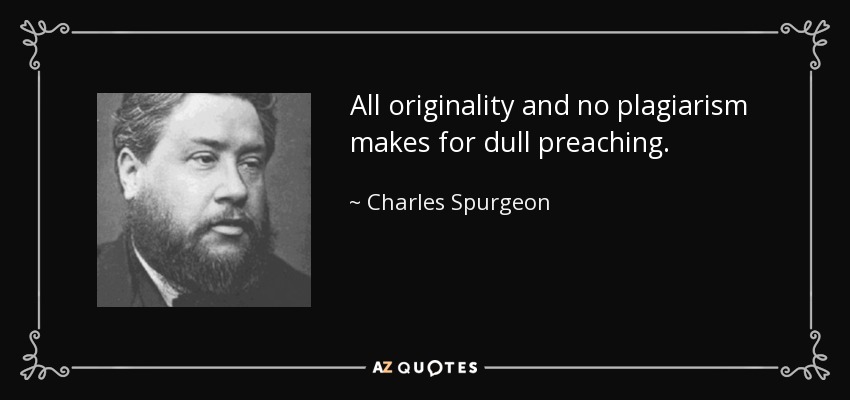
I'm not sure Spurgeon said, " All originality and no plagiarism makes for dull preaching." or not. If he did say it, he uttered those words in a different era and, I suspect, tongue in cheek. The words do provide some balance to the discussion. While it may not be good enough anymore--at least not all together--I think there is still some truth in the words of Solomon. I have applied them to sermonizing many times. "There is nothing new under the sun" (Ecclesiastes 1:9). Or, as one young preacher is reported to have cried out, "The ancients have stolen my ideas." If I come up with something truly original it is probably truly wrong. Maybe someone will come up with a list of iron-clad (that refers to two battleships in the American Civil War) rules for when to cite and when not to--I sincerely doubt that will happen--we have to do the best we can. Our goal is to effectively communicate God's truth. We can't let extra-Biblical rules interfere with that. Yet, we must be people of integrity. If we aren't, we forfeit any opportunity to speak for God. It's harder than it looks. Maybe we can help each other. Let's start a conversation. Let us know how you handle this issue in the comments section, below.